
Signs of Japan's rapid hydrogen fuel system energy rollout are finally beginning to show up on the nation's streets. The only question now may be how fast the "H2 revolution" overtakes the land.
Hydrogen refueling station maker Iwatani Corporation is planning for a dramatic reshaping of the domestic landscape as the government's "Strategic Road Map for Hydrogen and Fuel Cells" enters its second full year this June. In it, the Ministry of Economy, Trade and Industry (METI) has called for at least 30% of Japan's energy to be derived from renewable sources by 2030.
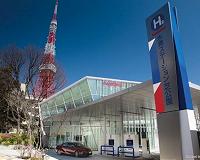
Together with solar, wind and other technologies, many see the hydrogen fuel cell market as claiming a sizeable chunk of that future. Iwatani has already set up a handful of H2 stations around the country, including one in Tokyo's Shiba Koen neighborhood last year. The company broke ground on a new Sendai facility last April in the nation's northeast region.
"The Tokyo station services about 10 vehicles a day, so it's not exactly a mecca for traffic yet," says Iwatani senior manager and engineer Toru Komatsudiara. "It's a bit of a 'chicken or the egg' scenario; either we build up the H2 infrastructure first and wait for hydrogen cars to be released, or wait for the cars to increase, then build the stations. We have adopted the former concept."
Iwatani is not alone in preparing for the coming hydrogen fuel wave. Japan's Big Three automakers-Toyota, Nissan, and Honda–have already pledged to spend a combined YEN 6 billion ($55 million) to help operate H2 refueling stations. The public-private sector cooperation had succeeded in putting over 80 of the units in place by end-March. The goal is for 1,000 locations to be set up by 2025.
One of the problems hindering a wider station rollout is the high cost; hydrogen stations run about $5 million each to build, and government subsidies cover only about half of that amount. Just as important, only a few FCVs (fuel cell vehicles) are currently in circulation.
Until March 2016, the Toyota Mirai was the only mass-produced H2 vehicle on the road, and only 700 were made in the first year (production launched in December 2014). Interestingly, Toyota includes three years of free fuel for Mirai buyers in California, but not in the domestic market.
This year, Honda began sales in Japan of its Clarity FCV, which boasts a 750-km cruising range and three-minute recharge time, comparable to the Mirai.
Nissan has been slower to the game, with CEO Carlos Ghosn appearing to back battery electric vehicles (BEVs) over hydrogen fuel cells. The company's Leaf electric car is the global all-time best seller in its class, having already passed the 200,000 unit milestone in December 2015. Five years after its introduction, nearly 60,000 of the cars are on Japanese roads. They can also be recharged at home.
Range and recharge time remain issues with electric vehicles, however. The Leaf can only run for about 170km before needed a recharge, which can take 30 minutes to complete.
Iwatani's own plans call for hydrogen stations call for a westward rollout from the Kanto (Tokyo area) to Chubu (Nagoya area), Kinki (Osaka area), and northern Kyushu. Current subsidies run through 2020.
"Much will depend on national policymakers and how METI's infrastructure plan is further refined, but we're confident that hydrogen fuel cells have advantages that will have a long-lasting place in the overall landscape," says Mr. Komatsudiara. "We need other carmakers to get on board quickly, though."
