
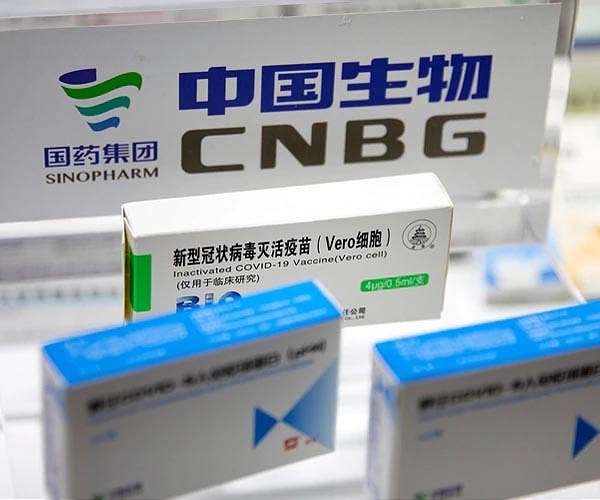
Hungary plans to begin administering the Chinese-made Sinopharm coronavirus vaccine to its citizens later this month, the government said Friday.
Hungary broke ranks with the EU last month by becoming the first bloc member to approve and order both Sinopharm and Russia's Sputnik V jab, in quantities of five million and two million doses respectively.
The Chinese shipment "is enough for 2.5 million people," Gergely Gulyas, Prime Minister Viktor Orban's chief of staff, told a press briefing in Budapest.
"That is enough for 250,000 people in each of February, March and April, and then the rest of the contracted amount after April," he said.
Orban, who previously said that he will choose the Chinese jab for his own inoculation, said Friday that the vaccine is "on its way", but added that further tests by the Hungarian authorities would have to be carried out.
Orban said during a radio interview that the experiences of non-EU member Serbia — which neighbours Hungary — with both the Russian and Chinese vaccines were "reassuring".
The first batch of Russian vaccines could be administered to Hungarians "perhaps next week" pending final approval by the local public health authority, Orban said.
Hungarian officials have criticised the slow pace of vaccine approval and procurement by EU authorities, which have so far sent the Pfizer-BioNTech and Moderna shots to Budapest.
So far, around 260,000 people have received at least the first dose of a coronavirus vaccine, while 92,000 people have been given both shots, Orban said.
The first shipment of the AstraZeneca vaccine is arriving in Hungary this weekend, enough for 20,400 people, and will be administered to chronically ill patients under the age of 60, Agnes Galgoczi, head of epidemiology at the National Public Health Centre, said Friday.
Hungary has been under a partial lockdown since November that includes an evening curfew, a ban on gatherings, and the closure of restaurants, schools and universities.
Gulyas said the government would weigh a gradual lifting of pandemic restrictions, with the first phase starting March 1 and the second on April 1, if there is no third wave.
Hungary's coronavirus statistics all improved during January, but have seen a small upturn in February so far.
China approves second domestic Covid-19 vaccine
Beijing (AFP) Feb 6, 2021 –
China's drug authorities have given "conditional" approval for a second Covid-19 vaccine, Sinovac's CoronaVac jab, the pharmaceutical company said Saturday.
The vaccine has already been rolled out to key groups at higher risk of exposure to coronavirus but Saturday's approval allows for its use on the general public.
A conditional approval helps hustle emergency drugs to market in cases when clinical trials are yet to meet normal standards but indicate therapies will work.
The approval comes after multiple domestic and overseas trials of the vaccine in countries including Brazil and Turkey, although "efficacy and safety results need to be further confirmed", Sinovac said in a statement.
Fellow Chinese pharmaceutical company Sinopharm received a similar conditional green light in December to put its vaccine on the market.
Sinovac said trials in Brazil had shown around 50 percent efficacy in preventing infection and 80 percent efficacy in preventing cases requiring medical intervention.
"The results show that the vaccine has good safety and immunogenic effect on people of all age groups," Sinovac said Saturday.
Meanwhile Sinopharm said in December that its vaccine had a 79.34 percent efficacy rate, lower than rival jabs developed in the West by Pfizer-BioNTech and Moderna — with 95 and 94 percent rates respectively.
China has been racing to develop homegrown jabs and aims to vaccinate 50 million people before the start of the Lunar New Year in mid-February.
The holiday normally spurs a travel rush with hundreds of millions traversing the country — though authorities are encouraging people to stay home this year through a mixture of restrictions and incentives.
As China ramps up its vaccine campaign, authorities have repeatedly assured the public of the jab's safety and efficacy, despite not releasing any detailed clinical trial data.
At the same time, Beijing has been promoting its vaccines abroad in what analysts have called "vaccine diplomacy" to earn goodwill after facing criticism for its early handling of the outbreak.
China's foreign ministry on Wednesday said it planned to provide 10 million vaccine doses to the WHO-backed international vaccine distribution programme Covax.
Beijing has also pledged to share the vaccine at a fair cost — a potential boost for poorer Asian countries who are otherwise reliant on limited distribution offered by the Covax scheme.
Countries including Senegal, Indonesia, and Hungary have procured millions of vaccine doses from Chinese pharmaceutical firms.
But take-up has been slower abroad for Chinese vaccines compared to jabs from Pfizer-BioNTech and Moderna, as little information has been published about the safety or efficacy of Chinese vaccines.
Chinese vaccine makers also have chequered reputations, after major scandals at home involving expired or poor quality products.
