
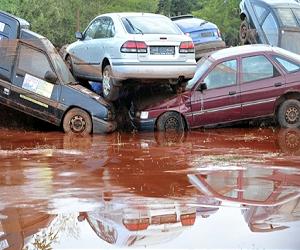
Fed up and exhausted, residents evacuated from Kolontar spent the weekend in shelters wondering when they will be able to return home, as fears grew of another toxic spill in their village.
They milled around their temporary abode in the nearby town of Ajka on Sunday, waiting for news about progress on a new dam being built should the reservoir of industrial waste fail again.
"Unfortunately we have to stay here for a few days, but once the new dam is ready we can all go home," said Peter, who spent the night on a camping bed in the Ajka sports centre.
"It was horrible last night. I should have slept in the car," he said.
Two other shelters have been set up in schools in the town, each with neat rows of some 250 camping beds, although most of the 800 villagers forced to evacuate are staying with family and friends.
Seven people died when a waste reservoir of an alumina processing plant burst on Monday , spewing 800,000 cubic metres of toxic sludge into the streets and homes of Kolontar and nearby rivers.
A woman, carrying bags of donated food, who was injured by the toxic flood said: "I can still walk and my hands are alright, but my legs were badly burnt."
A volunteer handing out clothes and nappies tried to reassure the evacuees.
"We are doing our best to get you all back to your homes, we ask for your patience, we know things aren't ideal here."
In Kolontar, the village's lower lying area — just a stone's throw away from the reservoir — remained a scene of devastation and now is doomed for complete destruction.
And hopes of a swift clean up and return to normal life in the rest of Kolontar were dashed on Saturday when a fresh crack appeared in the reservoir wall. Authorities rushed to build a new dam to protect the houses that had avoided the first toxic flood.
"In two or three days there is going to be rain and we are trying to speed things up so that we can finish off the dam before the rain comes," Zoltan Illes, Hungary's state secretary for environmental protection, told reporters at the dam construction site.
Soldiers and police armed with machine guns blocked main roads leading to the reservoir, which is 100,000 square metres in area, and only allowed emergency teams through.
An AFP correspondent was able to reach the area on Sunday, which remains caked in stinking red mud that is slowing drying.
The landscape at the reservoir was one of post-industrial dereliction, with rusty pipes criss-crossing the tops of the 20-metre-high dykes.
The gap where the dam burst is 50 metres wide and is impossible to approach other than by air due to mud that is three metres deep.
It will likely take construction crews months to rebuild the broken dyke, as they are forced to plug the gap by dropping concrete blocks into it from the air.
"I am not a disaster tourist," said local man Gyorgy Racz, who had come to inspect the damage. "I'm doing the community a favour by seeing everything with my own eyes."
Share This Article With Planet Earth
