
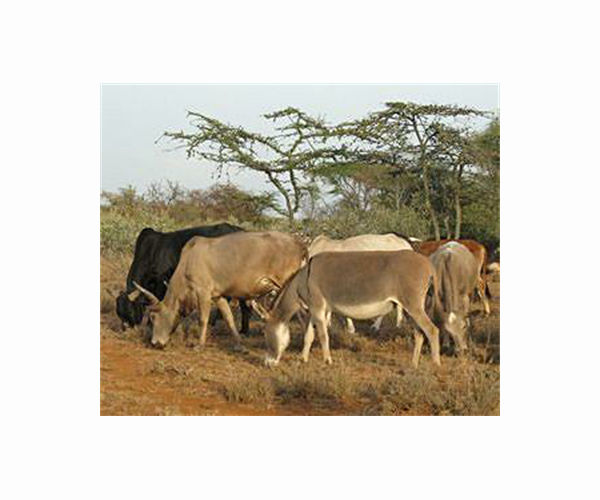
For thousands of years, horses and donkeys have been some of our species' most important partners.
A new study published Thursday shows they're also friends to desert animals and plants, by digging deep wells that provide a vital source of water, especially at the height of summer.
Biologist Erick Lundgren, lead author of the paper in Science, told AFP he first began noticing the phenomenon while working in western Arizona as a field technician studying river systems.
"People just didn't think it was worthy of scientific attention," said the scientist, who is now at the University of Technology Sydney.
Lundgren had read about African elephants digging wells that were the only source of water for other animals during the dry season, and wanted to know if horses and donkeys might play a similar role in America.
The idea was intriguing, "especially since donkeys and horses are considered agents of biodiversity harm" as they are not native species in the region, he said.
Over the course of three summers, he and his team surveyed sites in the Sonoran Desert that stretches across Arizona and California.
They documented the relative contribution of wells dug by horses and donkeys compared to the surface water that was available to animals from desert streams, some of which are intermittent while others are permanent.
The team also set up camera traps to learn how other animals were utilizing the wells.
– 'Invasion biology'? –
They found that wells dug by the "equids" to depths of up to six feet (two meters) increased water availability for many native desert species, and decreased the distances between important water sources during dry periods.
The wells were especially important during the hottest and driest parts of summer, when they provided the only available water source at some sites.
Lundgren said the horses and donkeys acted as "buffers" against the extreme variability of desert streams from year to year.
"The donkey wells kept water in the system. And these features were used by pretty much every species you could picture, including some surprising ones like black bears, that we didn't expect to see in the desert," he said.
Other species that flocked to the wells and were caught on camera included mule deer, bobcats, Woodhouse's scrub jay and javelinas.
The team even spotted some river tree species sprouting from abandoned wells, indicating they also serve a role as plant nurseries.
Horses and donkeys were introduced to the Americas by Europeans to assist with the colonization of the continent, but their use declined with the advent of the internal combustion engine.
Since then, they have been studied as "invasion biology," said Lundgren, which does not consider them to be a part of the local wildlife.
But this thinking is too tunnel-visioned and has prevented scientists from having a more nuanced understanding of their effects on their ecosystems, he argued.
Lundgren and his colleagues said in their paper that the wells will be increasingly important as human activity and climate change reduces the number of perennial streams in these regions.
Another element to the story is that the behavior of modern horses and donkeys might have an "ancient precedent," said Lundgren.
Horses, elephants and other large animals that roamed North America until a mysterious extinction event around 12,000 years ago could have once fulfilled a similar role.
Polluted Lebanon lake spews out tonnes of dead fish
Qaraoun, Lebanon (AFP) April 29, 2021 –
Tonnes of dead fish have washed up on the shore of a highly polluted lake in eastern Lebanon in the past few days, an official said Thursday.
It was not immediately clear what caused the fish kill in Lake Qaraoun on the Litani river, which several local fisherman said was unprecedented in scale.
A preliminary report said a virus had killed only carp in the lake, but a veteran water expert said their deaths could also have been caused by pollution.
Hundreds of fish of all sizes lay dead on the banks of the more than five kilometre (three mile) long lake Thursday, and the stench of their rotting flesh clung to the air.
Men shovelled carcasses into a wheelbarrow, as a mechanical digger scooped up more into the back of a truck.
"It's our third day here picking up dead fish," said Nassrallah el-Hajj, from the Litani River Authority, dressed in fishing waders, adding they had so far "carried away around 40 tonnes".
On the water's edge, 61-year-old fisherman Mahmoud Afif said it was a "disaster".
"In my life I've never seen anything like it," said the father-of-two.
The Qaraoun lake was built as a reservoir on the Litani river in 1959 to produce hydropower and provide water for irrigation.
But in recent years experts have warned huge quantities of wastewater, industrial waste, and agricultural runoff containing pesticides and fertiliser flooding into it have made it increasingly toxic.
– 'Toxic bloom'? –
Since 2018 fishing has been forbidden in the reservoir as the fish there was declared unfit for human consumption, though fish from the lake have continued to appear in several markets.
The Litani River Authority and the Society for the Protection of Nature in Lebanon on Friday warned of a "viral epidemic", and called for fishing to be forbidden in the Litani as well as in the lake.
It said the likely disease had only affected carp, while four other types of fish appeared to be unaffected.
Kamal Slim, a water expert who has been taking samples of water from the lake for the past 15 years, said pollution could also be the cause.
"Without analysis, we cannot be decisive," said the researcher.
But the lake is also home to cyanobacteria, or blue-green algae, and in warmer months the excess nutrients from pollution have caused the bacteria to erupt into bright green blooms that release toxins.
"Right now there is a cyanobacteria bloom, though less thick than last year," he said.
That or a bacteria could be responsible for harming the fish, especially since they are weaker during the reproduction season.
"Another possibility is very toxic ammonium," he said.
In July 2016, Lebanese media reported that tonnes of fish floated to the surface overnight in the Qaraoun lake.
Slim said that was due to a toxic bloom and oxygen depletion.
