
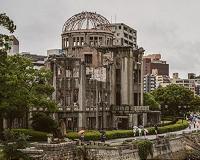
With a blinding flash of light and an ear-splitting roar, the age of nuclear conflict arrived with terrifying and awe-inspiring force on August 6, 1945, changing the course of history, and killing 140,000 people.
The morning was a run-of-the-mill one for most Hiroshima residents. Housewives made breakfast for their families, children played in the sticky summer heat, and men hurried to get ready for work.
Few could have known the dangers above them as a US B-29 bomber, the Enola Gay pierced the sky, loaded with deadly cargo in its belly, the single most fearsome weapon the world had ever seen.
At 8:15 am, the pilot released Little Boy, a uranium bomb with a destructive force equivalent to 16 kilotons of TNT.
After the initial searing fireball, gusts of around 1.5 kilometres (one mile) a second roared outwards, carrying with them shattered debris, and packing enough force to rip limbs from bodies.
The air pressure suddenly dropped, crushing those on the ground, and an ominous mushroom cloud rose, towering 16 kilometres above the city.
The smell of burning flesh filled the air as scores of badly injured survivors tried to escape the inferno by diving into the rivers that criss-crossed Hiroshima.
Countless hundreds never emerged, pushed under the surface by the mass of desperate humanity; their charred bodies left bobbing in the brackish water.
Many died of their terrible injuries over the following hours and days; lying where they fell, desperate for help that would never come, or even just for a sip of water.
For those who survived, there was the terrifying unknown of radiation sickness still to come.
Gums bled, teeth fell out, hair came off in clumps; there were cancers, premature births, malformed babies and sudden deaths.
Seven decades later, some stone buildings that survived the supersonic blast still bear the shadows of anything — or anyone — that was incinerated in front of them.
The mangled skeleton of a domed exhibition hall — the only structure left standing near the epicentre — stands as a grim reminder of the power of the world's first atomic bombing, a sight that Barack Obama will see Friday when he becomes the first sitting US president to visit the city.
The Hiroshima attack was followed three days later by the Nagasaki bombing. In the wake of the overpowering twin bombs, Japan surrendered less than a week later, ending World War II.
Key dates in the nuclear arms race
Hiroshima, Japan (AFP) May 27, 2016 –
Here is a timeline of the development of nuclear weapons, as US President Barack Obama pays a historic visit to the Japanese city of Hiroshima on Friday.
Hiroshima and Nagasaki are the only two cities to suffer an atomic bombing, by US planes in August 1945.
– June 1942: The United States launches the top-secret "Manhattan Project" to build an atomic bomb before the Nazis do. More than $2 billion is spent to achieve that goal.
– July 1945: The early morning "Trinity" test takes place in New Mexico, marking the dawn of the nuclear age.
– August 1945: On August 6, a US bomber drops an atomic bomb built with uranium on Hiroshima, killing 140,000 people and wounding tens of thousands.
Three days later, a second atomic bomb with plutonium fuel smashes Nagasaki, killing 70,000 people. On the 15th, Japan surrenders.
– August 1949: Four years after Hiroshima and Nagasaki are destroyed, the Soviet Union successfully tests its own atomic bomb in Kazakhstan. Britain becomes the world's third nuclear power with an A-bomb test in Australia in October 1952.
– November 1952: The US tests its first hydrogen, or thermonuclear bomb (H-bomb), in the Pacific. It is almost 700 times more powerful than an atomic bomb. The Soviet Union tests its first H-bomb in 1953, followed by the British in 1957.
France then tests an A-bomb in February 1960, as does China in October 1964. Both countries follow suit a few years later with H-bomb tests.
– February 1967: The Tlatelolco treaty declares Latin America a nuclear-free zone. It is followed by other treaties that cover the Pacific, South-East Asia, and Africa.
– July 1968: Britain, the Soviet Union and the United States sign the Non-Proliferation Treaty (NPT) which takes effect in March 1970.
– May 1998: India and Pakistan become nuclear powers.
– October 2006: North Korea, which withdrew from the NPT in 2003, detonates an atomic device, and follows with three more tests since then. North Korea is also developing ballistic missile technology.
In December 2006, Israeli authorities let it be known they possess nuclear weapons, and the country is also developing long-range missiles.
– April 2010: Russia and the US sign a second Strategic Arms Reduction Talks (START) agreement to replace one signed in 1991. It calls for a significant reduction in the nuclear weapons arsenals of both countries. Britain is also reducing its stocks, while France and Israel are believed to be maintaining a stable level. According to the Federation of American Scientists, China, India, North Korea and Pakistan are building their inventories of warheads.
– July 2015: An agreement between Iran and major powers is signed with the aim of ensuring that Iran's nuclear programme remains limited to civilian purposes. In exchange, international sanctions against Iran are lifted.
According to the Stockholm International Peace Research Institute (SIPRI), the number of nuclear warheads has decreased, but the nine known nuclear powers continue to develop more sophisticated nuclear weapons.
In early 2015, SIPRI estimated the total number of nuclear warheads worldwide at 15,850 of which 4,300 are considered operational. In 2010 the numbers were estimated at 22,600 and 7,650 respectively.
Russia and the United States account for most of the reduction, but they still hold about 7,500 for the former and 7,260 for the latter, or 90 percent of the total.
