
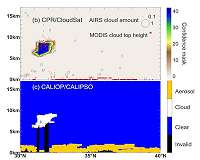
It is very important to observe and study cloud properties because clouds play an important role in weather, climate, and the Earth's energy balance. Satellite remote sensing is commonly used to obtain a variety of cloud properties. Haze pollution can reduce human's vision, but will it also affect the accuracy of satellite cloud detection?
In a paper published in Atmospheric and Oceanic Science Letters, Dr. TAN Saichun, Ms. ZHANG Xiao, Prof. SHI Guangyu, and co-authors from Institute of Atmospheric Physics, Chinese Academy of Sciences compare cloud detection from four sensors – MODIS, CALIPSO, AIRS and CloudSAT – onboard the "A-Train" satellite constellation during two severe haze episodes in winter 2015-2016.
They find, on haze days, the MODIS true-color image and CALIPSO observed an aerosol layer in eastern China. The AIRS, CloudSat and CALIPSO did not observe continuous cloud there over the haze region.
However, MODIS observed continuous cloud, suggesting MODIS misclassified aerosol as cloud. Over the haze region in eastern China, MODIS observed a 13%-49% greater cloud fraction than AIRS.
"So in severe haze weather, we would suggest that the cloud product of MODIS should be used with caution." says TAN, the lead author of the study.
China launches remote sensing satellites in multiple launches
China launched remote sensing satellites at 2:10 am, Beijing Time, Saturday on a Long March-2C rocket from Xichang Satellite Launch Center in southwest China's Sichuan Province.
The satellites has entered the preset orbit and Saturday's launching mission was proclaimed a success.
The satellites will conduct electromagnetic probes and other experiments.
The launch is the 256th m … read more
