
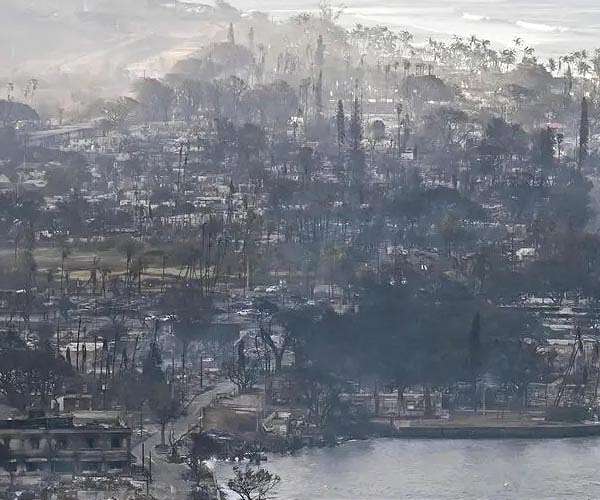
Hawaii's governor has warned that the death toll from last week's wildfires could double or even triple over the next 10 days, as the grim task of searching for charred human remains slowly continued Monday.
At least 96 people are confirmed to have died on the island of Maui, in what is already the deadliest US wildfire in a century.
But Governor Josh Green said more fatalities are certain, as emergency responders with cadaver dogs work their way through hundreds of homes and burned-out vehicles.
"They will find 10 to 20 people per day probably until they finish. And it's probably going to take 10 days," he told CBS in an interview aired Monday.
"It's impossible to guess, really."
The historic Maui coastal town of Lahaina was almost destroyed by the fast-moving inferno last week, with survivors saying there had been no warnings.
With some cell phone communications now restored, residents have been able to reconnect with family and friends, and the number of people still missing has been reduced from more than 2,000 to around 1,300, said Green.
"Our hearts will break beyond repair, perhaps, if that means that many more dead. None of us think that, but we are prepared for many tragic stories," he said.
The town, which served as the Hawaiian kingdom's capital in the early 19th century, was home to around 12,000 residents, as well as a bustling tourist street packed with shops and restaurants.
Now, "there's nothing to see except full devastation," said Green, who has visited the smoldering streets of rubble and ash multiple times.
The intensity of the fire and scale of the destruction have made identification of human remains difficult.
Police are encouraging those with missing relatives to give DNA samples that might speed up the process.
"The remains we're finding are from a fire that melted metal," said Maui Police Chief John Pelletier. "When we pick up the remains… they fall apart."
– Questions over alert system –
The wildfire is the deadliest in the United States since 1918, when 453 people died in Minnesota and Wisconsin, according to nonprofit research group the National Fire Protection Association.
Questions are being asked about how prepared authorities were for the catastrophe, despite the islands' exposure to natural hazards such as tsunamis, earthquakes and violent storms.
A class-action lawsuit has been filed against Hawaiian Electric, the state's biggest power firm, claiming the company "inexcusably kept their power lines energized during forecasted high fire danger conditions."
"By failing to shut off the power during these dangerous fire conditions, Defendants caused loss of life" and extensive damage, alleges the lawsuit, seen by AFP.
Hawaiian Electric said in a statement that the company does not comment on pending litigation, and noted that the cause of the fire has not yet been determined.
Whatever sparked the terrifying inferno, a collision of circumstances — including a churning hurricane off the coast — meant that it spread very quickly.
Maui suffered numerous power outages during the crisis, preventing many residents from receiving emergency alerts on their cell phones.
No sirens sounded and many Lahaina residents spoke of learning about the blaze from neighbors running down the street or seeing it for themselves.
"The mountain behind us caught on fire and nobody told us jack," resident Vilma Reed, 63, told AFP.
"You know when we found that there was a fire? When it was across the street from us."
– 'Aloha spirit' –
Maui's fires follow other extreme weather events in North America this summer, with record-breaking wildfires still burning across Canada and a major heat wave baking the US southwest.
Europe and parts of Asia have also endured soaring temperatures, with major fires and floods wreaking havoc.
Scientists say human-caused global warming is exacerbating natural hazards, making them both more likely and more deadly.
In Lahaina, more than 2,700 buildings were damaged or destroyed as the fire tore through the town, according to official estimates, wreaking $5.5 billion in damage.
Hundreds of hotel rooms are being made available for free to victims, with long-term rehousing options using Airbnb vacation homes also being explored, said Green.
Communities have been launching their own initiatives to cope with the tragedy.
Volunteers including celebrity chefs at the University of Hawaii culinary school in Kahului, about 30 miles (50 kilometers) east of Lahaina, cranked out thousands of fresh meals on Sunday for those affected.
"Some of our chefs have lost their homes (in the fire), and they're right here right alongside us cooking for their community," Sheldon Simeon, a Maui-based chef known nationally as an ambassador of Hawaiian cuisine, told AFP.
"Just gives you a sense of what the 'aloha' spirit is," Simeon said.
The deadliest wildfires
Paris (AFP) Aug 14, 2023 –
The US wildfire in which almost 100 have died in Hawaii is among the most deadly of the 21st century.
Some previous wildfires:
– Australia –
In "Black Saturday" in Australia's Victoria state, 173 people were killed, in Australia's worst bushfire on February 7, 2009.
Whole towns and more than 2,000 homes were destroyed.
– Greece in 2007 and 2018 –
In Greece's worst-ever fire disaster, 103 people died when wildfires swept through homes and vehicles in the coastal town of Mati near Athens in July 2018, leaving only charred remains.
The majority of the victims were trapped by the flames as they sat in traffic jams while trying to flee. Others drowned while trying to escape by sea.
In 2007, a 12-day inferno starting in late August killed at least 67 people and destroyed 800 homes across the southern Peloponnese peninsula.
The flames engulfed most of the region's olive groves. The Aegean island of Evia was also badly affected.
In all 77 people died that summer due to fires.
– Algeria in 2021 and 2022 –
More than 90 people, including 33 soldiers, were killed in dozens of wildfires in Algeria in August 2021.
The government blamed arsonists and a blistering heatwave for the blazes, but experts also criticised authorities for failing to prepare for the annual wildfire season.
In August 2022, massive blazes killed 37 people over several days in northeastern El Tarf province, near the border with Tunisia.
More than 10,000 hectares (25,000 acres) went up in smoke in El Kala National Park, a UNESCO-listed heritage spot famous for its rich marine, dune, lake and forest ecosystems.
– 2018: California – –
On November 8, 2018 at dawn, California's deadliest modern fire broke out in the town of Paradise, some 240 kilometres to the north of San Francisco, killing 85 people over more than two weeks.
It burned more than 62,000 hectares of land and reduced more than 18,800 buildings to ashes.
An investigation found that high tension electricity wires sparked the fire.
The Camp Fire is likely the most deadly fire in the United States for a century; the Cloquet Fire in 1918 in the northern state of Minnesota killed around 1,000.
– Portugal in 2017 –
The deadliest wildfires in Portugese history broke out in the central Leiria region during a heatwave in June 2017 and burned through hills covered with pine and eucalyptus trees for five days.
Many of the 63 people who died became trapped in their cars while trying to escape.
In October, a new series of deadly fires broke out in northern Portugal, killing another 45 people as well as four in neighbouring Spain. Those fires were chiefly blamed on arsonists.
