
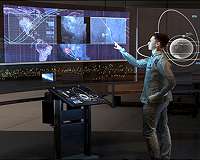
The growing complexity of space operations coupled with an increased need for timely decisions demands innovative approaches to battle management command and control (BMC2) technologies.
To help ensure future U.S. technological and strategic superiority, DARPA's Hallmark program seeks to develop revolutionary tools and technologies to plan, assess, and execute U.S. military operations in space.
The program has completed initial research and awarded Phase 1 contracts to 11 organizations, which both augment existing commercial technologies and pursue entirely new capabilities. Hallmark has released a Broad Agency Announcement seeking additional technologies for potential inclusion.
"Twenty-first-century space BMC2 must enable commanders to quickly understand and handle situations by optimizing delivery and presentation of crucial information to make decisions, then provide flexible options for effective, timely response," said Lt. Col. Jeremy Raley, program manager in DARPA's Tactical Technology Office (TTO).
"Hallmark aims to more quickly, collaboratively, and cost-effectively develop unprecedented space BMC2 tools."
The Hallmark Tools and Capabilities 2 (Hallmark-TC2) BAA aims to develop and validate additional technologies to complement and augment the Hallmark-TCEM tools and capabilities currently being integrated into the Hallmark software testbeds.
A Proposers Day for Hallmark-TC2 is scheduled for Tuesday, January 30, 2018 at the DARPA Conference Center in Arlington, Virginia. Registration information is available here. (Please email questions to [email protected].)
Hallmark's Phase 1 research seeks to develop a modular system that could quickly and easily add, remove, and exchange tools from multiple providers. Hallmark Tools, Capabilities and Evaluation Methodology (Hallmark-TCEM) is developing the first set of tools and technologies, as well as providing one of the first instances of using cognitive evaluation to inform development of tools for U.S. military command and control.
Cognitive evaluation involves well-established research methods for assessing situational understanding and awareness, including qualitative (interviews) and quantitative (logging human-machine interaction) data collection during and after testing.
DARPA is using this discipline to more quickly discover which tool and task combinations most effectively convey information, contribute to operators' understanding of situations, and enhance real-time decision making.
"Everyone says they can build 'better' human-to-machine interfaces, but how is 'better' being measured?" asks TTO Director Fred Kennedy.
"Normally, we rely on subjective interpretations from operators at consoles. Hallmark's unique insight is that we should be able to use quantitative methods to accurately and reliably measure cognitive performance. That's a big step forward."
SpaceX to Launch US Government Mystery Satellite Sunday
Technology pioneer Elon Musk's aerospace firm, SpaceX, is preparing to launch a secretive spacecraft for an unnamed branch of the US government this weekend after postponing the event in November. Codenamed Zuma, the launch was initially scheduled for November from NASA's Kennedy Space Center at Merritt Island, Florida. SpaceX delayed sending Zuma into space after concerns emerged about the nose cone protecting the payload from dynamic pressure and aerodynamic heating on its way out of the atmosphere. Multiple media outlets reported that Zuma would take off on Thursday, January 4, but SpaceX has pushed the event date back again to Friday, and now Sunday at the earliest. … read more
