
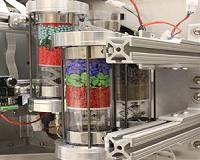
The secret to planetary formation and working on asteroids lies in a handful of glass beads and meteorite fragments.
These materials are the main component for the Astromaterials Research and Exploration Science (ARES) experiment Strata-1, a payload designed to test how regolith, or impact-shattered "soil", acts on small, airless bodies like asteroids, comets and the Moon.
Strata-1 is set to launch to the International Space Station aboard Orbital ATK's Cygnus spacecraft on March 22, and will help us learn how easy or difficult it is to anchor a spacecraft in regolith and how regolith will interact with spacecraft and spacesuit materials.
This knowledge is fundamental to the Asteroid Redirect Mission (ARM), an integral part on our Journey to Mars. Through ARM we will advance new technologies and gain spaceflight experience.
In order to successfully complete ARM and continue on our Journey to Mars, it is essential to understand how the ground could shift under the spacecraft or the astronaut and how the "soil" could impact vital systems. Strata-1 will help give us that understanding.
Strata-1 is composed of four transparent tubes that house materials of different shapes and sizes. Cameras will take photos as the materials interact with microgravity and, every three months, the space station crew will send down the images for processing.
The photos will be analyzed a couple of ways as well as edited together into time lapses to show the movement of the materials in microgravity. (Be on the lookout for those in the coming months!)
This experiment is, as Deputy Project Manager Kristen John, Ph.D. said, "A true science experiment," and one regolith experts have been looking forward to for 25 years.
The highly anticipated investigation faced its share of challenges. The Strata-1 team had a tight budget and a 10-month deadline. The developmental process of typical flight projects has a 36 month template, more than three times Strata-1 allotted time.
By using already existing flight hardware and doing much of the work in house, the Strata-1 team came in just under budget. By working with the team behind the development of flight projects, Strata-1 met its deadline.
In fact, because of the Strata-1 team's work, the development process of flight projects has been dramatically streamlined, and it can now easily adapt to accommodate a 10 month timeline.
Strata-1 was developed under Principal Investigator Marc Fries, Ph.D. with Project Manager Lee Graham, Deputy Project Manager Kristen John, Ph.D., and a dedicated science team. Together, they worked with groups across NASA and higher education to create an experiment for the space station in a third of the traditional time and under budget.
