
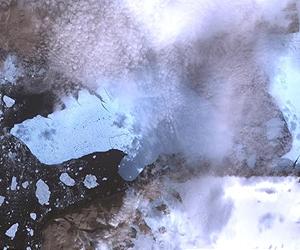
A giant iceberg four times the size of Manhattan that split off from a Greenland ice sheet last month has split in two, U.S. satellite images show.
The ice island broke apart after smashing into Joe Island, a small rocky outcrop in the Nares Strait west of Greenland, CNN reported Saturday.
The ice island split from the Petermann Glacier in early August, moving up the Petermann Fjord and into the Nares Strait in early September.
The ice island first hit Joe Island last week, and broke apart after repeated collisions.
"The forces of the ocean currents and the winds wiggling it on and off the island were too much," Andreas Muenchow, an associate professor at the University of Delaware, said.
The larger of the two pieces is about 60 square miles, or around 2.5 times the size of the New York borough of Manhattan, while the smaller piece is around 32 square miles, he said.
The break off in August was the biggest in 140 years, Muenchow said.
"We went back to 1876 to find all glacier positions that have ever been reported. From this analysis, we found that this indeed was the largest event that has been observed at Petermann," he said.
earlier related report
Sea temperatures around Japan hit record high in August
Tokyo (AFP) Sept 10, 2010 –
Japan, which has just endured its hottest summer on record, said Friday it had also last month recorded the warmest sea temperatures since it started gathering comparable data 25 years ago.
Ocean surface temperatures in much of the archipelago's Pacific Ocean and Sea of Japan waters reached more than 25 degrees centigrade (77 degrees Fahrenheit) in August, said the Japan Meteorological Agency.
The average sea temperature was the hottest recorded since 1985 when the agency started a new measuring system, and was also a record 1.2 degrees centigrade above the average for the 1971-2000 period.
"When examining the earlier data also, I would say global warming is one of the factors behind the warmest recorded sea waters," said an agency official.
Scientists warn that the greenhouse effect caused by heat-trapping gases in the atmosphere is raising global temperatures, melting the planet's ice caps and triggering more severe weather events such as storms and floods.
Japan this year experienced its hottest summer since records began in 1898, with thousands of people taken to hospital with heatstroke. The average temperature for June to August was 1.64 degrees centigrade above average.
Share This Article With Planet Earth
