
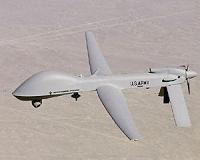
The Department of Defense on Monday announced a new contract with General Atomics Electromagnetic Systems Group for the Low Power Laser Demonstrator Phase 1 effort.
The deal, worth more than $8.8 million, is a competitive cost-plus-fixed-fee contract that will enable General Atomics to perform the "next step" for the development of the LPLD that addresses "laser power and aperture size by integrating and testing a low power laser on an unmanned aerial vehicle," the Pentagon said in a news release
In June, the Missile Defense Agency started looking into acquiring and deploying a laser-armed drone to intercept and shoot down intercontinental ballistic missiles.
The MDA Advanced Technology Directorate has said it needs a high-altitude long-endurance unmanned aerial vehicle with sufficient payload capacity to carry a high-energy laser. It would be designed to intercept ICBMs during their boost phase. It has not ruled out a manned platform as well.
Work on the contract will be performed in San Diego, Calif., and Poway, Calif., with an estimated completion date of July 31, 2018.
Fiscal 2017 research, development, test and engineering funds in the amount of $2 million have been obligated at the time of award.
At its most basic level, a random laser is precisely what its name implies; random. It's random in the spectrum of light it produces and in the way that light is emitted, making what could be an extremely versatile laser source, nearly useless for most practical applications.
So, how do you control some of the randomness to make useful devices? It's a question that's led a team of research … read more
