
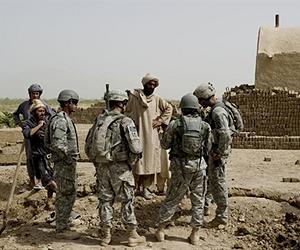
US Defense Secretary Robert Gates said Saturday that only a "very modest" number of international troops will remain in Afghanistan after a projected 2014 withdrawal.
On a visit to Chile, part of a four-day trip to South America designed to bolster military cooperation in the region, Gates said in a speech that he expected "some fraction" of the international forces in Afghanistan "will remain to train and provide support for the Afghans."
He suggested troops will recalibrate their mission like that in Iraq, where foreign forces ostensibly remain in the country in an advising capacity.
"What we've done is embrace a goal that was established by President (Hamid) Karzai, that by the end of 2014, the primary responsibility for security across all Afghanistan would have been transitioned to Afghan forces," said Gates.
NATO leaders meeting in Lisbon have pledged to begin the process of handing over responsibility for security to the Afghan police and military from next year, with a view to ceding full control by the end of 2014.
Gates was holding talks in Santiago with his Chilean counterpart, Jaime Ravinet, before heading to Bolivia for a conference of regional defense ministers that is expected to focus on a "hemisphere-wide mechanism to more effectively channel disaster relief," according to US officials.
On the sidelines of the conference, Gates is expected to meet with defense ministers from Bolivia, Brazil, Colombia and El Salvador.
earlier related report
No British combat troops in Afghanistan after 2015: Cameron
Lisbon (AFP) Nov 20, 2010 –
Britain will withdraw all of its combat troops from Afghanistan before the end of 2015, Prime Minister David Cameron promised on Saturday, making what he called a "firm commitment".
"The commitment we have entered into today to transfer lead responsibility for security to the Afghan government by the end of 2014 will pave the way for British troops to be out of Afghanistan by 2015," he said.
"This is a firm deadline that we will meet," he told reporters at the NATO summit in Lisbon, staking out a tougher position on troop withdrawals than other NATO allies, who have not set a final cut-off date for operations.
NATO members agreed on Friday that they would begin to hand over command of some regions to Afghan forces next year, and aim to have the Afghan government take charge of the war against the Taliban in 2014.
But the largest coalition member, the United States, has made it clear that it expects to have troops in combat alongside Afghan forces beyond then.
Britain has the second largest commitment to the NATO-led mission, with some 10,000 soldiers in Helmand province in the violent south of the country.
Cameron said he thought the alliance would understand his decision, and paid tribute to British troops for having taken on one of the toughest of NATO's missions.
"We will have an ongoing relationship with Afghanistan. We spend development money in Afghanistan. We will still have a diplomatic relationship … we may well have troops helping to train their armed forces," he said.
"But what I'm saying is, from 2015 there won't be troops in anything like the numbers there are now. There won't be combat troops. That is completely consistent with what NATO said," he insisted.
"But I think the British public need to know, that after having gone into Afghanistan in 2001, after having gone into Helmand province in 2006, having taken such a huge share of the burden … that there is an end point."
British forces have lost 345 troops in Afghanistan since joining the 2001 US-led invasion, which aimed to hunt down the Al-Qaeda leaders responsible for the 9/11 attacks on New York and Washington.
Once the Taliban regime was toppled, and Al-Qaeda's commanders had fled, the mission became a long-term counter-insurgency against Taliban guerrillas and public support for the war collapsed.
Share This Article With Planet Earth
