
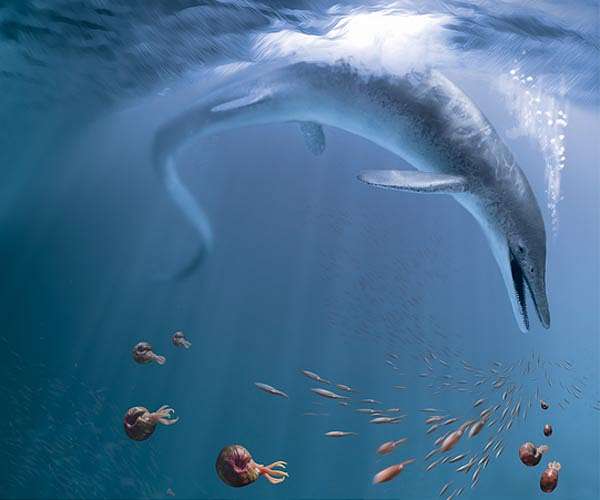
Scientists have unearthed fossils belonging to what may have been one of the largest-ever animals to inhabit Earth, according to research published this week.
Fossils of three new ichthyosaurs were discovered in high-elevation localities in the Kössen Formation in the Canton of Grisons of the eastern Swiss Alps, and may prove to be among the largest animals to have ever lived, paleontologists said in the study, published Wednesday in the Journal of Vertebrate Paleontology.
They represent the only published partial skeletons of large to giant ichthyosaurs younger than middle Norian, a division of the Triassic Period, which occurred between 227 million and 208.5 million years ago.
Ichthyosaurs were large marine reptiles which are now extinct.
The discoveries include the largest ichthyosaur tooth ever found, as well as a postcranial bone association of one very large vertebra and ten rib fragments.
The width of the tooth root is twice as large as any known aquatic reptile. The previous record was held by a 15-meter-long ichthyosaur.
"The incomplete tooth confirms that at least some giant ichthyosaurs had teeth. Based on their proportional differences, the two bone associations may represent two different taxa of ichthyosaurs," researchers wrote in the study.
Scientists had debated whether the mammoth creatures did in fact have large teeth or instead fed on things like large quantities of small fish.
Ichthyosaurs early on colonized the open ocean, explaining their occurrence throughout the northern hemisphere, according to researchers.
