
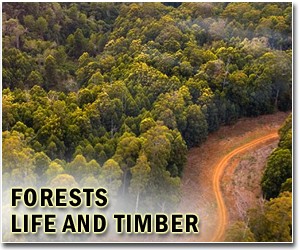
While the deforestation of tropical rainforests is seen as a major contributor to greenhouse gas emissions, the impact of cool-weather rainforests tends to be overlooked when addressing climate change, a panel of scientists said.
These "forgotten" rainforests store more carbon per acre than tropical rainforests, the scientists said in Washington Wednesday while introducing "Temperate and Boreal Rainforests of the World: Ecology and Conservation," a book to be released next month.
Temperate and boreal rainforests are found in 10 regions of the world, including the coastal rainforests that stretch from the California Redwoods to British Columbia and Alaska, to the lesser-known rainforests in South Africa, Japan, Europe and the Russian Far East.
In the United States, the Top 10 national forests with the highest carbon storage are in western Oregon, Washington and Alaska. These rainforests store nearly 9.8 billion metric tons of carbon dioxide equivalents or roughly twice the amount of the nation's emissions from burning fossil fuels annually, the book says.
"The redwoods and our coastal rainforests are incredibly good at storing carbon for long periods," said forest ecologist Dominick DellaSala, editor and principal writer of the book, the Mail Tribune newspaper in Medford, Ore., reports.
"They are a big sponge for carbon. In fact, the redwoods and coastal forests up into Alaska have to be the best carbon storage on the planet, along with the Australian rainforest."
But DellaSala said that less than 14 percent of the nation's forests are protected from logging and other resource development threats.
"As the United States engages in international efforts to prevent deforestation in developing countries, the Obama administration should protect carbon-rich older forests here at home from logging," said DellaSala in a news release.
"The United States should lead by example and we should expect at least as much of ourselves as a nation that we ask of others, especially those with fewer resources to address deforestation."
The nation's temperate rainforests account for just a fraction of their once historic size: between 15-20 percent of old-growth rainforests remain in the Pacific Northwest and less than 4 percent of the region's coastal redwoods are still standing.
"The great temperate rainforests of many other countries are long gone," said Paul Alaback, professor emeritus of Forest Ecology at the University of Montana and one of the book's co-authors. "The U.S. has some of the most significant remaining temperate rainforests on federal lands in the world and has the responsibility to move swiftly to protect them."
earlier related report
Macedonia plants seven million trees to revive its forests
Skopje (AFP) Nov 19, 2010 –
Macedonians took a day off work on Friday to plant seven million trees as part of a project started in 2008 to revive fire-ravaged forests in the landlocked Balkan country.
"The main goal of the 'Plant together for all of us' initiative is to protect the environment and increase ecological awareness among citizens, especially to bring together children and parents to plant the trees together," said organiser, opera singer Boris Trajanov.
About seven million nursery plants — mostly cypresses and pine trees — were planted at around 80 sites throughout the country, he said.
Trajanov and his associates, backed by the government, launched the action in March 2008 after raging fires ravaged about 35,000 hectares (86,500 acres) of greenery in Macedonia.
Since then more than 20 million trees have been planted in planting days held twice a year, in March and in November.
Trajanov, a prominent Macedonian opera singer and UNESCO Artist for Peace, said the initiative "has gained popularity and massiveness" in the past two years.
"Now you can often see people planting trees in their yards and neighbourhoods," he said.
Every summer wildfires destroy thousands of hectares of forests in Macedonia, especially in the southern part of the country. They are mostly caused by human error, but also high summer temperatures in summer.
Experts said that restoring the damaged ecosystem could take up to 50 years.
Share This Article With Planet Earth
