
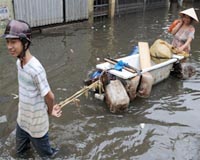
Rains again hit northern Vietnam Friday as authorities in the capital Hanoi moved to contain the spread of dengue fever and other diseases following the worst floods to hit the city in over 35 years.
At least 180 cases of the mosquito-borne disease were reported by Hanoi hospitals in a six-day period, state media reported, as officials warned of other disease threats in neighbourhoods flooded with dirty water.
At least 82 people have been killed since unseasonal rains started hitting north-central Vietnam late last month and then Hanoi a week ago, according to collated reports from city and provincial emergency services.
More than 800 millimetres (32 inches) of rain pounded Hanoi in five days, swelling the Red River and its tributaries, and inundating rice fields and more than 120,000 buildings.
Rumours in Hanoi this week that a rain-soaked dyke could burst saw hundreds of residents run to shops to stock up on drinking water, food and supplies.
Upstream from the capital, earthmoving equipment was being used Friday to reinforce a Red River dyke with 12,000 cubic metres of boulders and rocks, said Nguyen Dac Thoa, deputy head of the city's dyke department.
Many Hanoi residents have complained of receiving little help from troops, police or volunteers when neighbourhoods disappeared under a metre (three feet) of brown floodwater, leaving thousands trapped in their homes.
Hanoi's Communist Party boss Pham Quang Nghi was forced to offer a public apology after he caused widespread public anger by appearing to belittle the suffering in the city where 20 people died in the floods.
Nghi had said on Sunday that "I found that, unlike in the old days, people rely a lot on the state. They just wait for the government to supply this, support that. They don't try their best to do it themselves."
Vietnam, a country of 86 million people, is lashed by typhoons and tropical storms from the South China Sea every year, mostly along the central coast.
Last year, seven major storms killed more than 435 people in floods and landslides, displacing thousands and leaving vast central areas inundated.
Share This Article With Planet Earth
