
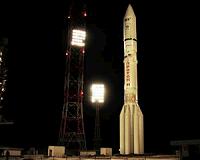
The latest of seven Proton carrier rocket failures over the past five years took place on May 16 during a mission to guide the Mexican government's Mexsat 1 satellite into orbit.
Design flaws in the rotor of the third stage engine caused the failure of a recent Proton-M mission, according to the results of the investigation into the incident, Russia's Federal Space Agency Roscosmos said Friday.
"The conclusion of the [investigation] commission: the cause of the failure of the Proton-M carrier rocket mission was the failure of the steering third stage engine due to excessive vibration as a result of imbalance in operation of a rotor of a pump unit," Roscosmos head, Igor Komarov, told reporters in Moscow.
"The failure was due to a design fault," Komarov stressed.
Russia will not give up on the use of Proton-M carrier rockets in space missions despite recent launch failures, Federal Space Agency Roscosmos said on Friday.
"As to the Proton launches, we believe that the measures that are being developed will allow us to ensure the success of future launches in the near future
Roscosmos to Decide on Revised 2015 Launch Schedule Next Week
Meanwhile, "Roscosmos will announce the next launch date for Proton-M carrier rocket sometime in June, 2015," Roscosmos head, Igor Komarov told reporters in Moscow.
According to Roscosmos, the revised schedule will affect both piloted missions and launches of space freighters.
The announcement came shortly after a state investigative commission reported the results of a probe into the failed launch of the Progress-M27M cargo spacecraft on board a Soyuz-2.1A carrier rocket on April 28.
The commission concluded that the failure had been caused "by an unexpected design incompatibility between the spacecraft and the rocket.
