
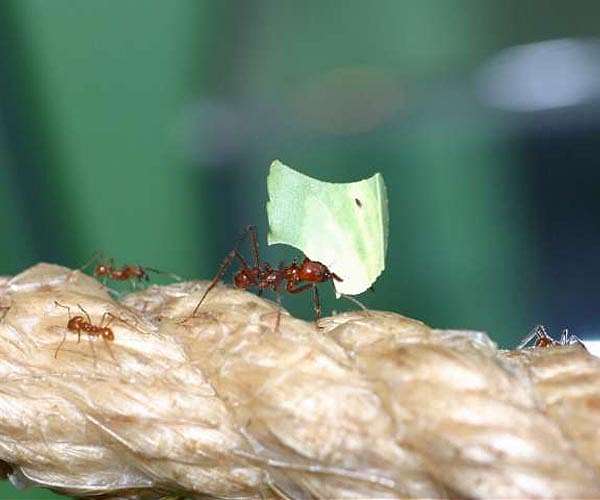
A new study explores the evolutionary relationship between attine ants and beneficial bacteria that live on their bodies, revealing that these ants developed specialized structures for hosting bacteria shortly after they began farming fungi. Attine ants are known for cultivating fungi, forming one of the best-documented mutualistic relationships in nature. In the 1990s, researchers discovered that these ants also harbor actinobacteria, specifically Pseudonocardia, on their exoskeleton. The ants secrete nutrients through subcuticular glands to support these bacteria, which in turn help protect the fungal crops by killing the pathogenic fungus Escovopsis.
Researchers led by Jacobus J. Boomsma sequenced 194 ant samples from 11 different attine species in Panama to study the coevolution of ants and their cuticular bacteria. The analysis found that three of these species, including two Acromyrmex leaf-cutting ants, had a significant presence of Pseudonocardia. In contrast, five other species hosted different actinobacteria, with no clear evolutionary patterns linking them.
Using transmission electron microscopy, the team observed that the ants' nourishment glands shared similar structures across different species, indicating that the ability to support cuticular bacteria likely evolved just once in attine ants, soon after they began farming fungi. This finding suggests that the ants' glands are versatile enough to nourish various bacterial strains, not limited to Pseudonocardia.
Phylogenetic comparisons showed that Pseudonocardia bacteria likely transitioned from being gut symbionts to residing on the ants' exoskeleton around 20 million years ago, aligning with the emergence of new ant genera in Central and North America. The study also suggests that previous conflicting results in this research area may be due to the failure to separate gut and cuticular samples during genetic sequencing, and because laboratory-kept ants can easily acquire non-native bacteria over time.
Research Report:From the inside out: Were the cuticular Pseudonocardia bacteria of fungus-farming ants originally domesticated as gut symbionts?
