
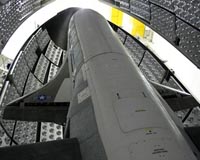
The intriguing X-37B robot spaceplane just can't stay grounded. Barely months after landing from a mission lasting more than two years, the next X-37B will blast off in August 2017. That's a quick turnaround, but it seems probable that the next spaceplane to fly won't be the same one that recently landed. The US Air Force, owners of the semi-secret spacecraft, has two vehicles, both with long missions to their credit.
It's fair to say that the US Air Force is now running X-37B flights routinely. The spacecraft seems very robust, staging flawless returns to Earth after long flights in low Earth orbit. It also looks fairly undamaged in photographs taken soon after landing. This must surely breed confidence in flying more missions, more often.
There's another development that makes X-37B flights more routine. They're switching launchers for the next mission. All previous X-37B launches have been made by the Delta V launch vehicle. This time, a SpaceX Falcon 9 rocket will carry the spacecraft.
Transiting a semi-secret military payload to this "new space" launch provider is a major victory for SpaceX, and a sign that the traditional stable of preferred government launch contractors is being challenged. It also suggests that SpaceX can be trusted to deal with anything sensitive on board the spaceplane.
This could be easier for X-37B than some classified satellites. Sensitive gear on X-37B is stored inside the spacecraft's payload bay, which is enclosed by clamshell doors. This means that the spacecraft guards its secrets fairly well, even before it is properly encapsulated in its payload fairing.
If the on-board payload requires no special support systems during processing, nobody will really know. Some clues could be obtained by knowing the total mass of the spacecraft, but it is not clear if this information will be disclosed openly.
Will SpaceX give us a view of the spacecraft before launch? That's a more critical question than ever before. The last launch of X-37B broke a previous policy of releasing vivid photography of the spaceplane before flight. We didn't see a thing. But the US Air Force was happy to show the entire landing. Was something inside the payload fairing too hot to show?
Giving this flight to SpaceX could be an indication that there's nothing too controversial outside the vehicle, or being carried along with the vehicle. But we will know more when we see how the engineering paparazzi act very soon.
Netherlands to replace ScanEagle UAV with Integrator
The military of the Netherlands is replacing its ScanEagle unmanned aerial vehicle systems with Integrator UAVs from Insitu.
The Integrator is a multi-mission small UAV that carries custom payloads for intelligence, surveillance and reconnaissance missions. It is the baseline aircraft for the RQ-21A Blackjack, a program of record with the U.S. Navy and Marine Corps that entered full-rat … read more
