
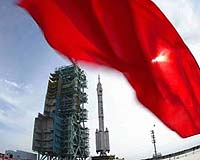
China's Shenzhou VII spacecraft will carry three astronauts into orbit this week to undertake the nation's first space walk.
Here are some details about Shenzhou:
— Shenzhou means "Divine Vessel" (or "God Vessel" or "Magic Vessel").
— It has a dome-shaped design and is comprised of three modules — a forward orbital module, a re-entry module and a service module at the back.
— The ship can seat up to three astronauts or "taikonauts."
— The basic design of the re-entry module is modelled after the Russian Soyuz vessel that was first launched some 40 years ago.
— The orbital module will be manned by two astronauts with one performing the space walk.
— The orbital module can remain in orbit after the re-entry module returns to earth and can serve as a building block for an eventual space laboratory.
— The first Shenzhou was launched on 19 November, 1999 and orbited the Earth 14 times before landing under parachute.
— Three subsequent Shenzhou spacecrafts were launched, leading up to the Shenzhou V, China's first manned mission in 2003 carrying a single taikonaut.
— Shenzhou VI, China's second manned space flight, carried two taikonauts on a five-day mission in 2005.
— Shenzhou capsules have flown at altitudes from 196 to 334 kilometres (122 to 207 miles).
— The capsules are built by the state-run China Aerospace Science and Technology Corp.
— The Shenzhou VII spacecraft will be launched by a Long March 2F rocket, the type used for years to ferry Earth orbit satellites.
