
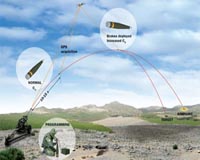
The European Defense Agency recently completed the Course Correction Fuze project, an effort aimed at improving the accuracy for artillery munitions.
The Course Correcting Fuze, or CCF, is designed to provide near-precision capabilities for conventional munitions by placing fins in the fuze body. Researchers say this approach can be used along with GPS technologies to make strikes with 155mm and 105mm munitions more accurate.
The EDA began the CCF project in 2012 with the agency's Smart Munition Working Group with the goal of identifying affordable solutions for reducing ballistic dispersion and boosting accuracy for conventional munitions.
Munition experts from EDA member states Belgium, Poland, Sweden and Britain participated in the project with additional support from Norway. Integration methods were developed in 2016 and delivered in early 2017.
The investigation was divided into three parts. For the first phase, researchers collected information on CCF solutions. Some solutions involved airbrakes for reducing down-range dispersion, while others used fixed or movable canards to reduce down-range and cross-range dispersion.
During the second phase, investigators integrated five CCF solutions into artillery systems used by EDA member states. The third phase focused on developing recommendations for participating armed forces.
The agency concluded it would be beneficial for EDA member states to develop common munitions and artillery systems, allowing CCF solutions to be integrated more easily.
Lockheed Martin introduces Paragon direct attack bomb
Lockheed Martin announced Thursday that its newest direct attack, Dual Mode Plus laser-guided bomb has been named Paragon.
Paragon leverages the reliability of the company's laser-guided bomb, or LGB, and integrates an inertial navigation system and GPS all-weather moving-target capability.
"The new brand Paragon exemplifies a model of excellence, and reflects the system's perfor … read more
