
EU governments hesitated Wednesday to back a clarion call by British Prime Minister David Cameron for trade-linked aid to help Pakistan battle flood devastation and fears of rising Islamist extremism.
National leaders will decide at a European Union summit in Brussels on Thursday whether to offer "ambitious trade measures essential for economic recovery and growth," according to newly-adapted conclusions obtained by AFP.
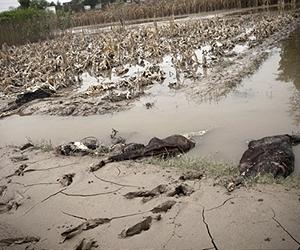
The floods have turned some 21 million lives upside down and left 1,760 dead.
In a letter to European Union partners, Cameron calls for a "concrete political commitment from the EU to Pakistan to enhance significantly its access to the EU market."
However, a welter of obstacles — not least the likelihood of a challenge at the World Trade Organization — means the bloc was playing it coy amid internal disagreement.
Heads of government and state from the 27 EU members, which represent the world's biggest border-free trading bloc and home to half a billion consumers, will above all be asked to agree "in principle" to grant "significantly increased market access… through the immediate reduction of duties on key imports."
Nevertheless, illustrating the depth of feeling among opponents, a watered-down version calls only on the European Commission, the EU's day-to-day executive, to "come forward with proposals including increased market access."
Cameron's push for special status at the WTO looks strewn with obstacles, as he admitted in the letter, but he will pursue what opponents call a liberal free-trade agenda with a drive for "an ambitious new partnership between the EU and Pakistan on serious economic reform and trade."
German Foreign Minister Guido Westerwelle said last week that the move was designed to prevent Pakistan from degenerating into "extremism and fundamentalism."
The commission, which polices EU trade matters, suggested that ministers consider ditching tariff barriers on 13 types of textile product, in an effort to kick-start an economic fightback.
But the idea of preferential treatment caused consternation within the industry.
The European association of textile producers (Euratex) argued that Islamabad was "using all sorts of excuses to demand free access to the EU market."
It added that Pakistan is "already a major world player" on a par with India or China, and warned that unilateral EU moves "will certainly be attacked" in the WTO and could "seriously jeopardise" negotiations on a free-trade deal with New Delhi.
earlier related report
US aid to Pakistan may delay non-military projects: envoy
Karachi (AFP) Sept 16, 2010 –
US special envoy Richard Holbrooke said Wednesday the use of a non-military aid package to fund flood relief instead in Pakistan may delay important water and energy projects in the country.
Holbrooke, the special US envoy for Pakistan and Afghanistan, told reporters in the southern port city of Karachi that 50 million dollars had already been diverted to flood relief from the Kerry-Lugar Bill.
The US Congress has advised the US government that it should use the 7.5-billion-dollar Kerry-Lugar bill, which finances non-military aid projects, to fund relief work to ease the devastation of Pakistan's recent floods.
"We may switch more money (from the Kerry-Lugar fund), which means some of the projects of the bill may have to be delayed because of emergency," Holbrooke said.
The Kerry-Lugar bill, named after two of the US Senators who sponsored it, became officially known as the Enhanced Partnership with Pakistan Act after it was signed into law by US President Barack Obama a year ago.
Holbrooke spoke to reporters after visiting southern Thatta district, where he saw some of Pakistan's communities worst-affected by the floods.
"Thousands of thousands of people… are in desperate need of water, food and sanitation. The United States has given you more assistance faster than any other country, but it is not going to be enough," Holbrooke said.
The monsoon floods which began six weeks ago have left 10 million people without shelter nationwide, according to UN figures, with 21 million people affected and eight million surviving on aid handouts.
Holbrooke said that the US people had donated generously towards helping the Pakistani people to deal with the flooding, which he described as "an epic catastrophe in human terms."
"The United States is helping Pakistan in this moment of greatest need not because of the war on terror, not because of what is happening in Afghanistan, but because your country needs help.
"We would be doing these things for Pakistan anyway," Holbrooke said.
He said he would be returning to the United States to raise more funds "with renewed determination," but feared that this would be insufficient.
"The international community is not going to be able to give all the money you need. It is just too large. Your country has to figure out how to raise enough revenues to pay for these projects," Holbrooke said.
Share This Article With Planet Earth
