
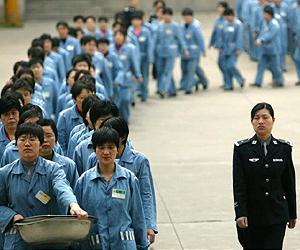
The European Commission on Thursday said it was ready to look at ways of slapping an import ban on Chinese goods allegedly made in forced labour camps, a move underway in the United States.
Under pressure from MEPs to take action against goods from the "laogai", or labour detention centres, commissioner Stefan Fule said the EU executive "is ready to study the effectiveness of the US law in preventing such imports."
"The laogai system is completely incompatible with universally accepted concepts of human rights, as well as China's ambitions to become a modern and developed society," he said.
Faced by calls from euro-parliamentarians to at least match US policy, Fule said the 27-nation bloc had consistently raised the matter with China but had prefrerred "an approach of positive engagement" rather than an outright import ban.
"However, we have to acknowledge that there are limits to this approach which, so far, has not produced any notable change in Chinese policy as regards laogai," he said.
In the United States, imports are banned from companies listed as being suspected of acting as fronts for gulag-style goods.
"It is extremely difficult to accurately establish whether — and which — goods imported from China into the European Union have been produced in laogai," Fule said.
Earlier this week, the EU's trade chief said Brussels will press Beijing for progress on human rights at an October 6 summit.
"Human rights are the silver threads of EU foreign policy," Trade Commissioner Karel de Gucht told the European parliament in Strasbourg.
"Even though significant differences continue it is important that we discuss human rights and the rule of law during the upcoming summit," he said.
The Brussels summit between the EU and a delegation led by Chinese Prime Minister Wen Jiabao is likely to focus heavily on the economic links between the biggest free trade area in the world and Asia's industrial powerhouse.
De Gucht urged China to ratify the international covenant on civil and political rights, saying it would be "the most tangible sign of China's commitment to respect human rights.
earlier related report
Namibia court postpones China graft case once again
Windhoek (AFP) Sept 23, 2010 –
A Namibian court Thursday postponed to next month the case of three suspects arrested in a graft probe involving a firm linked to the son of China's President Hu Jintao.
The three men appeared briefly in the Windhoek high court, where judge president Petrus Damaseb put the trial off to October 21.
They were granted bail in a lower court in August 2009, one month after their arrest as part of a probe into bribery allegations involving Nuctech, a company headed until 2008 by Hu's son, Hu Haifeng.
They were arrested after the southern African state's Anti-Corruption Commission discovered that a 12.8 million US dollar down payment on 13 security scanners had been diverted to a firm called Teko Trading. Teko assets were also frozen.
Nuctech representative Yang Fan was granted bail of 250,000 Namibian dollars (31,000 US, 22,000 euros), while Namibian nationals Teckla Lameck and Jerobeam Mokaxwa of Teko Trading each got bail of 50,000 Namibian dollars.
Yang's bail was later increased to one million Namibian dollars. He has been in prison since his arrest because he could not raise the bail money.
Yang's lawyer Richard Metcalfe asked the court Thursday to halve the bail money to 500,000 Namibia dollars, a request the judge said he would consider Monday.
He also asked that Yang be allowed to stay in Walvis Bay, 400 kilometres (250 miles) west of Windhoek, where his law firm is based.
Deputy prosecutor general Danie Smal argued a move to the coast could present a flight risk.
"There might be flight opportunities, there is a harbour and many Chinese ships call at the port," Smal argued.
Hu's son was president of Nuctech until 2008, when he was promoted to Communist Party secretary of Tsinghua Holdings, which controls Nuctech and more than 20 other companies.
Nuctech has a Namibian government contract to supply security scanning equipment in a 55.3 million US dollar deal, paid for with a Chinese loan granted when President Hu visited the country in 2007.
All three accused later drew large sums from the Teko account, with Yang taking 16.8 million Namibia dollars, spending it on houses, farms and luxury cars.
Share This Article With Planet Earth
