
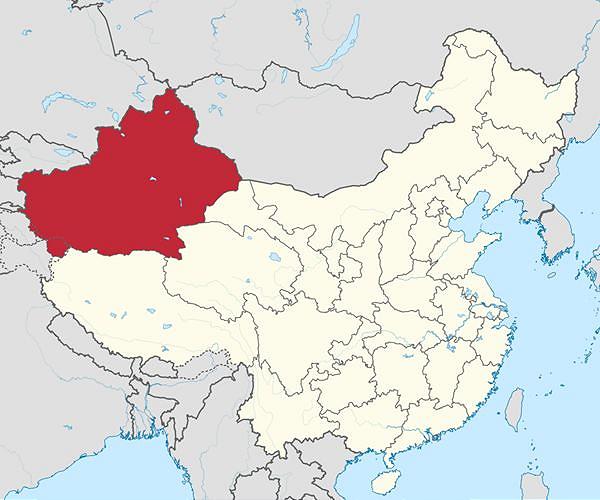
EU member states have agreed to impose sanctions on four Chinese officials and one state-owned entity over Beijing's crackdown on the Uighur minority, European diplomats said Wednesday.
Ambassadors from the 27 countries gave the green light for the measures as part of a package of human rights sanctions that will also see individuals in Russia, North Korea, Eritrea, South Sudan and Libya targeted, diplomats said.
The sanctions — set to hit around a dozen people in total with asset freezes and visa bans — have to be formally confirmed by EU foreign ministers meeting on Monday.
China has already reacted angrily to the prospect of punishment over its actions in the western Xinjiang region.
"Sanctions based on lies could be interpreted as deliberately undermining China's security and development interests," Zhang Ming, Beijing's ambassador to the EU, said on Tuesday.
"We want dialogue not confrontation. We ask the EU side to think twice. If some insist on confrontation we will not back down as we have no options but fulfilling our responsibilities to people of our country."
Rights groups believe at least one million Uighurs and other mostly Muslim minorities have been incarcerated in camps in the northwestern region, where China is also accused of forcibly sterilising women and imposing forced labour.
China has strongly denied allegations of forced labour involving Uighurs in Xinjiang and says training programs, work schemes and better education have helped stamp out extremism in the region.
The EU faces a delicate balancing act over relations with China as it treats Beijing as a rival and also a potential economic partner.
Brussels late last year sealed a major investment pact with China after seven years of negotiations, but is under pressure from the administration of new US President Joe Biden to form a united front against Beijing.
Washington on Wednesday added 24 more senior Chinese officials to its blacklist over Beijing's clampdown on democracy in Hong Kong.
The EU is expanding its new global human rights sanctions regime after launching it this month with sanctions on four Russian officials over the jailing of Kremlin critic Alexei Navalny.
Diplomats said the fresh sanctions on Russia are set to target individuals behind abuses in the country's Chechnya region, which is ruled with an iron-fist by Kremlin loyalist Ramzan Kadyrov.
Critics accuse Kadyrov, 44, of creating a fiefdom built on widespread rights abuses and amassing vast personal wealth.
Authorities in the conservative Muslim region have also come under fire in recent years from rights groups over the alleged jailing and torturing of gay men in secret prisons.
Kazakhs take Xinjiang protest to China's doorstep
Almaty, Kazakhstan (AFP) March 18, 2021 –
Gulnur Kosdaulet's daily journey to protest over her husband's detention in China begins with a shared taxi that she hails outside her modest farm, where towering mountains give way to Kazakhstan's vast steppe.
An hour and a half later she arrives at Beijing's consulate in the Central Asian country's largest city Almaty, where a small picket has persisted for over a month despite police intimidation.
The demands of the mostly female demonstrators are simple: safe passage home for their relatives — who are missing, jailed or trapped in China's crackdown on minorities in the northwestern Xinjiang region.
Kosdaulet, 48, told AFP that she would have "sat quietly by the hearth and never given politics a thought" had her husband, who is a Chinese citizen, returned from a funeral he attended in Xinjiang 2017.
She says he was detained simply for having WhatsApp on his phone and although he has now been freed after stints in jail and "training facilities", his passport has been seized and he cannot leave China.
"Kazakhstan and China are friendly. We hold these protests hoping the two governments will find common ground and return our people," she said.
In recent years, majority-Muslim Xinjiang has become known the world over for China's network of detention camps.
Dozens of international experts in a report for the Newlines Institute think tank said this month that Chinese policies there violated "each and every act" prohibited by the United Nations Genocide Convention.
So far, only the United States has accused China of genocide but the Dutch and Canadian parliaments have both passed votes calling on their governments to follow suit.
– Last hope –
But Beijing says its actions are needed to combat extremism, with foreign Minister Wang Yi calling allegations of genocide "preposterous".
Nowhere is the tension between these competing narratives more keenly felt than Kazakhstan.
While Kazakhs are concerned over the fate of thousands of their relatives trapped in China, their government relies on Beijing for investments to bolster a flagging economy.
Every morning that the protest outside the Chinese consulate starts up, so too does a police loudspeaker.
The message repeated on loop warns protesters their actions are illegal and they could face prosecution.
"They wanted to drown us out," said Baibolat Kunbolat, a 40-year-old man whose brother was jailed in Xinjiang in 2018 on charges of extremism that he believes are trumped up.
Kunbolat last month became the second person to be imprisoned over the consulate pickets. He served a 12-day sentence but joined the protests again shortly after.
At one point, after leading a chorus of "freedom", a woman standing next to Kosdaulet holding two photographs broke down in tears.
"I am looking for my husband Zharkynbek," said the woman, Tursyngul Nurakai. "He disappeared four years ago. This is my nephew Kenzhebek. He was sentenced to 10 years in jail."
Most of the protesters have filed appeals with the government to engage with Beijing over their relatives — Chinese citizens who in some cases held Kazakh residency permits.
But the demonstrators stress that they now see the pickets as their only hope and many say their government has given up trying to get their loved ones back.
– 'I just want to see him' –
At the end of 2018, Kazakhstan's foreign ministry said China had allowed 2,000 ethnic Kazakhs to enter Kazakhstan as a "kind gesture".
But since the releases, news that other relatives had received jail sentences — sometimes after stints in high-security facilities that China has likened to vocational training centres — has become far more common.
Kosdaulet's husband Akbar, a 47-year-old veterinarian and former provincial official, has now been separated from his family for three years.
Kosdaulet told AFP he can now contact her, but cannot return to Kazakhstan, where the family moved in 2014.
The mother of three travelled to China four times to bring him back, meeting him once through a glass barrier.
She was spared detention herself, she believes, because of her Kazakh passport. On each visit, surveillance grew tighter.
"The last time I went, in 2018, I was trailed by a police car everywhere I went," she said.
When the protests at the Chinese consulate began in February, Kosdaulet brought along her mother-in-law, Sarkytkhan Kydyrbay.
But after a few protests the journey became too much for the stocky 74-year-old, who is doubled up with joint pain and "going blind from tears", Kosdaulet said.
As Kosdaulet settled Kydyrbay down on traditional padded floor covers in the family's spartan living room, the older woman grew emotional, embracing the air as she spoke about her son.
"I've lived my life. I just want to see him, kiss him. Then I can die," she said.
