
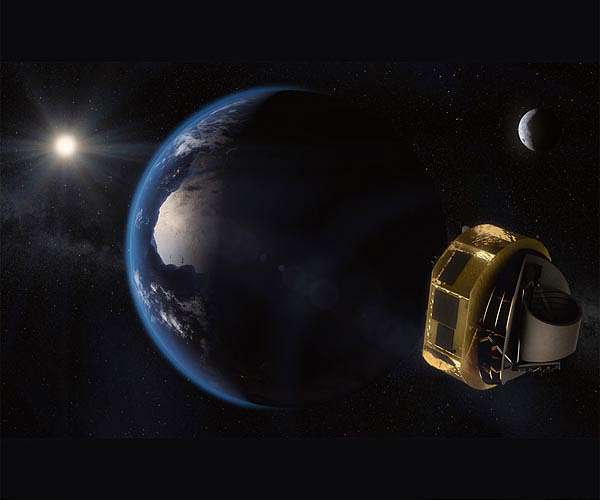
The European Space Agency said Thursday it's moving forward with an ambitious mission to study exoplanets and plans to start by the end of the decade.
ESA said it will choose a contractor to build a state-of-the-art spacecraft that can study various exoplanets for composition and clues as to how they evolved.
The studies are part of the ESA's Ariel mission, which it says will launch in 2029.
Ariel, short for Atmospheric Remote-sensing Infrared Exoplanet Large-survey mission, will be the first to attempt to measure chemical composition and thermal structures of distant exoplanets.
"Ariel will enable planetary science far beyond the boundaries of our own solar system," Gunther Hasinger, ESA director of science, said in a statement.
"The adoption of Ariel cements ESA's commitment to exoplanet research and will ensure European astronomers are at the forefront of this revolutionary field for the next decade and well beyond."
Giovanna Tinetti, professor of physics and astronomy at the University College of London, is the principal mission investigator and the spacecraft's mirror system and instrumentation will be developed and tested by RAP Space in Oxfordshire, Britain.
"We're very good at exoplanet research in [Britain]," said Caroline Harper, head of science at UK Space Agency. "We've got one of the largest science communities in the world. So, yes, we want to have a big part in Ariel."
Over the past 10 years, the ESA has developed two other missions focusing on exoplanets — one that launched last year and another set to launch by 2026.
