
Damaged ecosystems are sending signals of global climate crisis and energy scarcity to wake human beings up to respond by reducing excessive carbon dioxide and producing green sustainable energy.
The enormous potential is maintained by piezocatalysis, the absence of daylight constraints and abundant energy sources, including vibration, water flow, friction, tidal power, water droplets and human movement. Piezocatalytic hydrogen evolution has emerged as a promising direction for the collection and utilization of mechanical energy and the efficient generation of sustainable energy throughout the day.
Piezoelectric materials for catalysis are emerging and enriching, including perovskite-type materials (e.g. BaTiO3, ZnSnO3, CH3NH3PbI3), wurtzite-type materials (e.g. ZnO, ZnS and CdS), two-dimensional (2D) materials (e.g. MoS2, Bi2WO6 and 2D black phosphorus) and organic polymer (e.g. poly(vinylidene fluoride) (PVDF), polydimethylsiloxane (PDMS) and graphite carbon nitride). Some wurtzite crystal materials with non-centrosymmetric (NCS) structure have been found to be promising piezocatalytic materials to alleviate the bottleneck of photocatalytic efficiency.
The typical NCS wurtzite structured CdS with a space group of P63mc and point group of 6mm shows piezoelectric effect, which is expected to effectively speed up the separation of carriers and increase the overall catalytic efficiency through piezoelectric polarization field. Unfortunately, the high-efficiency piezocatalytic hydrogen production of CdS-based materials has remained challenging so far, which is limited to the rapid recombination and deactivation of photogenerated carriers.
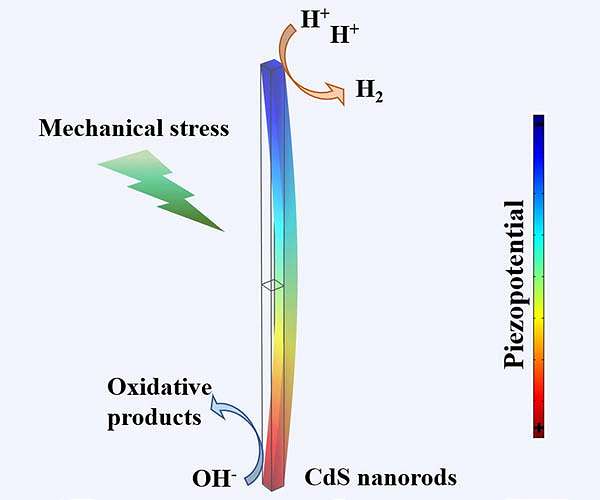
Recently, a research team led by Prof. Hongwei Huang from China University of Geosciences (Beijing) reported that two types of CdS nanostructures, namely CdS nanorods and CdS nanospheres, were prepared to probe the above-mentioned issues. Under ultrasonic vibration, CdS nanorods afforded a superior piezocatalytic H2 evolution rate of 175 umol g-1 h-1 in the absence of any co-catalyst, which is nearly 2.8 times that of CdS nanospheres.
The higher piezocatalytic activity of CdS nanorods is derived from their larger piezoelectric coefficient and stronger mechanical energy harvesting capability, affording a greater piezoelectric potential and more efficient separation and transfer of intrinsic charge carriers, as elucidated through piezoelectric response force microscope, finite element method, and piezoelectrochemical tests. This study provides a new concept for the design of efficient piezocatalytic materials for converting mechanical energy into sustainable energy via microstructure regulation.
Research Report: to promote piezocatalytic hydrogen evolution
