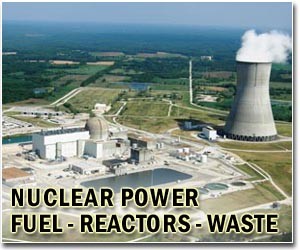
Egypt announced on Wednesday it would build its planned nuclear powerplant on the Mediterranean coast of el-Dabaa which it hopes will start production in 2019, the state news agency MENA reported.
Presidential spokesman Suleiman Awad said President Hosni Mubarak had decided in a meeting that the reactor would be located in el-Dabaa, on the coast west of the port city of Alexandria.
The meeting was "extremely important and represents a transition on the path to implement a strategic programme to ensure power supplies and peaceful uses for nuclear energy," the agency quoted Awad as saying.
An electricity and energy ministry spokesman said the government hopes the powerplant would be linked to the national grid in 2019.
He said the ministry would open an international tender for the plant which will be decided by the end of this year.
"We hope it will be up in 2019," said Aktham Abu el-Ela. "You know we have a crisis when it comes conventional fuel. This will be a stable source of energy," he said.
Electricity minister Hassan Younis had earlier estimated it would cost about four billion dollars (3.1 billion euros) for a 1,000 megawatt powerplant.
Egypt has already used several foreign companies as consultants, including French nuclear reactor producer Areva and US giant Westinghouse Electric Co.
Ela said the Dabaa plant would be followed by three other reactors, tentatively scheduled to start production in 2025.
On a visit to Cairo in June, Yukiya Amano, head of the UN's International Atomic Energy Agency, said the nuclear watchdog was ready to assist Egypt, which signed the Nuclear Non-Proliferation treaty in 1981.
Egypt first started its atomic programme in the 1980s but froze it after the 1986 Chernobyl nuclear disaster in the Ukraine.
Mubarak had in March ratified a law to regulate nuclear activities as the country of 80 million moves away from conventional fuels amid a growing strain on its power grid and depleting oil reserves.
The electricity ministry said in June the country would open its first solar energy plant by the end of this year, which he said will be among four in the world with a 140 megawatt capacity.
It has also begun operating wind farms, with the target of producing 20 percent of its energy from renewable resources by 2020, 12 percent of it from wind.
Egypt would be the fourth Middle Eastern country with a nuclear powerplant.
The United Arab Emirates awarded a South Korean power equipment manufacturer Doosan Heavy Industries and Construction a 20 billion dollar contract last December to build four 1,400-megawatt reactors by 2020.
Israel has a nuclear plant to produce energy, and widely acknowledged to have an undeclared arsenal of nuclear bombs.
Iran, which denies strong suspicions that it is seeking a nuclear bomb, is set to start operating its nuclear powerplant by the end of the year.
Share This Article With Planet Earth