
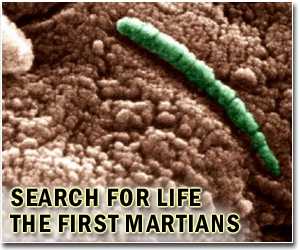
Common Earth bacteria could, in theory, survive in a dormant state in the harsh conditions on Mars for more than a million years, U.K. researchers say.
Scientists as University College London froze some Deinococcus radiodurans bacteria to minus 110 degrees Fahrenheit, the average temperature at Mars' mid-latitudes, then exposed it to Gamma radiation at a level it would receive under 11 inches of martian soil, NewScientist.com reported Tuesday.
The researchers estimate the bacteria could survive 1.2 million years under these conditions.
"The more we learn about Earth life, the more likely it appears that it could survive in other parts of the solar system," Cassie Conley of NASA says.
Conley, who minimizes the risk of NASA missions contaminating other worlds with microbes, says the agency's policy on planetary protection already takes into account that some microbes are amazingly radiation resistant.
"The policy is that we won't contaminate other planets or moons, because just one colonizing event could screw up our ability to study indigenous life forever," she told New Scientist.
Share This Article With Planet Earth
