
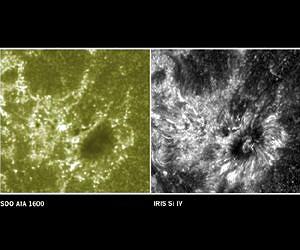
Image sensors designed and manufactured by e2v, a leading global provider of solutions for space, have captured their first images of the Sun on board NASA's Interface Region Imaging Spectrograph (IRIS) spacecraft, which was designed and built by Lockheed Martin.
IRIS is a NASA Explorer Mission to observe how solar material moves, gathers energy and heats up as it travels through a little-understood region in the sun's lower atmosphere. Understanding the interface region is important because it forms the ultraviolet emission that impacts near-Earth space and Earth's climate.
Energy traveling through the region also helps drive the solar wind, which, during extreme space weather events near Earth, can affect satellites, power grids and Global Positioning Systems (GPS).
For this mission, e2v supplied four identical Charged Coupled Device (CCD) image sensors, three in the main spectrograph and a single detector in the ultra violet slit jaw imager, to monitor the overall light level and provide context for the main spectrograph data.
The image sensors are 1024 by 2048 pixels with 13 um pixels. The detectors are custom versions of commercially available sensors produced using enhanced processes and thin-gate technologies.
Peter Fochi, VP of business development at e2v commented: "We are very pleased to be continuing our successful relationship with Lockheed by supplying high performance image sensors for the IRIS programme. e2v has provided image sensors to Lockheed for solar missions including SDO and SUVI. We very much look forward to seeing the high resolution images from the IRIS mission."
