
Drone operators flying over long distances or through radio traffic know that clear signal reception can mean the difference between mission success and failure. To that end, achieving so-called "zero signal latency" is the industry's Holy Grail.
For drone equipment maker AMIMON, it's a veritable calling card. The 11-year old Israeli company develops and manufactures HD wireless video modules that replace cable connectivity with minimal loss of latency-the delay between signal transmission and mechanical response.
Long a player in more traditional integrated circuits (IC), the company has recently turned its talents toward the exploding global aerial drone market, where sensitivity to latency is high. One year into the start of its Japan operations, the firm ran a busy booth at the first annual Japan Drone 2016 expo held in Chiba's Makuhari Messe last March.
"The Japan market is booming, and just like in the U.S. and Europe, more and more users are piling in," says AMIMON customer support engineer Idan Pearl. "But with (transmission) bandwidths getting crowded, signal processing is becoming more important than ever."
Amimon functions as an OEM, but also makes its own CONNEX brand. One of the company's hallmark products is the AMN 2120/2220 transmitter and receiver chipset, which allows full HD support of 1080p and 3D A/V formats at a latency of less than 1 millisecond.
The unit's Dynamic Frequency Selection (DFS) capability is a key component of the system. DFS is a mandate for radio systems operating in the 5GHz band, as it can identify and take action to avoid other radio transmissions that are considered primary-use or mission-critical, such as military and civilian airport radars, and some police and emergency equipment.
While there are local agencies in every country that regulate the use of RF (radio frequency) spectrum, DFS is a standard requirement of the International Telecommunications Union (ITU), and thus critical for commercial 5GHz product makers. AMIMON's gear can be tailored for both professional and more casual users, but it makes primary use of 5.1GHz and 5.8GHz bands.
"Professional drones are expensive, and the sophisticated cameras, sensors and other gear they carry can be even more pricey, meaning that a sizeable investment can be put at risk," says Mr. Pearl.
"For toys flown indoors, interference is not a worry. But for serious outside use, not outfitting a UAV (unmanned aerial drone) to deal with the bandwidth issue is very risky."
The problem in Japan is complicated by government?broadcast regulations, which many see as archaic. Currently, the country's Aviation Act prohibits flying drones over residential areas or areas surrounding an airport without permission from the Minister of Land, Infrastructure and Transportation. Flying drones at night and during public events is also prohibited.
In addition, UAVs in unrestricted areas are required to observe a 150 meter ceiling and to stay at least 30 meters from people, buildings, and vehicles. Rule violators are subject to a fine of up to YEN 500,000.
Industry players are hopeful for change, however. For example, while radio signals controlling drones are now capped at 10 milliwatts, enough for transmitting images within around 300 meters, current proposals are calling for the limit to be lifted to 1 watt, which would allowing a range of around 5km. This would make it easier to send ultrahigh-resolution 4K video suitable for such applications as detailed scanning of roads and bridges for cracks and other defects.
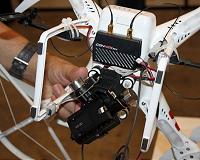
AMIMON's high-end "plug-and-fly" gear allows for viewing of recorded images in real time, and also manipulation of the camera gimbal. It requires no pre-flight calibration.
The firm counts film studios and aerial photography outfits among its major clients.
"We're hopeful that the legal changes will come into effect by year-end," says Mr. Pearl. "There is great potential for drones in Japan across many areas, and if the government can get more into step with industry, the country has a chance to be a real leader in the field."
