
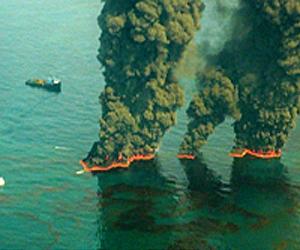
Since disaster struck the Deepwater Horizon drilling platform in the Gulf of Mexico on 20 April 2010, up to nine million litres of crude oil have been gushing into the sea every day.
It remains to be seen whether the recently installed 40-ton cap can really stop the majority of the oil flowing from the wellhead, 1500 metres under the sea. The spill will only be stopped definitively when the relief wells are completed in mid-August. But is this catastrophe the beginning of the end for deep sea drilling?
Even if BP itself may well be in difficulty because of the disaster, the global oil industry will hardly give up exploring deep-sea oil reserves.
Even US President Barack Obama failed to enforce a temporary stop to drilling at a New Orleans court. Thirty-two oil companies contested the stop order, and although the White House may well appeal against the decision, the outcome of such an appeal is far from certain.
An end to drilling in the North Sea?
Deep sea drilling is going on at around 350 sites in European waters. Following the disaster in the Gulf, EU Energy Commissioner Gunther Oettinger has decided not to grant any new drilling licenses – but only for the time being, until the causes of the Deepwater Horizon spill have been determined.
European oil companies are pushing to explore and exploit new oil fields, since reserves, especially in the North Sea and North Atlantic, are dwindling.
There is certainly a good chance that safety measures will be improved on deep-sea platforms worldwide. But it is senseless to propose that oil companies from the industrialised West should shut down their operations, according to analyst Volker Steinbach from the Federal Office for Geo-sciences and Resources (Bundesanstalt fur Geowissenschaften und Rohstoffe; BGR) in Hanover.
"In such a case I can only imagine that China would immediately snap up the licenses," he says. And it seems pretty doubtful that China would implement similarly stringent safety standards.
Brazil's oil reserves are even deeper than the Gulf of Mexico's
The emerging economy of Brazil is similarly unlikely to abandon its recently discovered reserves, off the coast northeast of Rio de Janeiro. Reserves in the Pre Sal area are estimated to be around 55 billion barrels (each barrel is 159 litres). These fields will be opened up in the near future, and could make Brazil the fourth largest oil producing country in the world.
But such business opportunities are always accompanied by risk. In order to exploit these fields, Brazil's Petrobras will have to drill at an ocean depth of 2000 metres and sink its wells seven kilometres deep. An even bigger technical challenge that that of the Gulf of Mexico.
Share This Article With Planet Earth
