
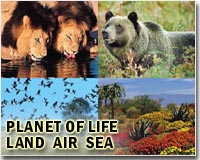
Overconsumption of the world's natural resources is unsustainably cutting into its ecological "capital," revered British naturalist David Attenborough warned Thursday.
"Financial systems have a lot in common with natural world systems. Both are economies," Attenborough said Thursday during the spring meetings of the International Monetary Fund and World Bank.
"If you deal with your investment… it's fine if you can take the profit, you take the investment, but you wouldn't be so silly as to eat into the capital. But that is what we're doing with the natural world all the time."
The BAFTA winner and long-time presenter of BBC wildlife documentaries spoke with IMF chief Christine Lagarde.
He said human beings and their domesticated animals now accounted for 96 percent of the global mass of all mammals.
"We've eliminated the rest," he said. "Seventy percent of all bird species have gone. We are in terrible, terrible trouble."
"I find it difficult to exaggerate the peril that we are in. We are in the process of a new fresh extinction which we know all about from geological time," said Attenborough.
"This is the new extinction — and we're halfway through it."
Early colonists in North America did not understand how their consumption of one species affected populations of others, he added.
He pointed to the hunting of sea otters for their fur, which increased populations of sea urchins that had been preyed upon by the otters. The urchins then consumed more kelp, reducing spawning grounds for fish, which had previously been a great source of wealth, said Attenborough.
"When you remove the kelp forests the fish could no longer survive," said Attenborough. "When you did realize it you could deal with it but it requires understanding."
He also warned the time had long since come to deal with climate change.
"The rate at which the climate is changing and warming, unless we act on the Paris Agreement to restrict that, we're going to be in real trouble," he said.
"Otherwise, if we just go on thinking this is going to be fine, we are going to be heading for major catastrophes. No doubt about that."
Common Costa Rican frog species consists of several 'cryptic' species
Washington (UPI) Apr 11, 2019 –
Scientists have discovered multiple "cryptic" species hiding inside a common Costa Rican frog species.
Warszewitsch's frog is found in Costa Rica, Honduras, Nicaragua and Panama. But according to a new study, not all Lithobates warszewitschii frogs are the same.
Scientists in Britain and Costa Rica used an analysis technique called DNA barcoding to compare snippets of DNA samples collected from dozens of Warszewitsch's frog specimens collected from three different locations in Costa Rica and Panama.
Genetic sequences from the specimens' mitochondria, the DNA powerhouses inside animal cells, revealed significant intraspecies diversity. The analysis showed the common species houses several cryptic species within it.
Cryptic species are groups within a single classified species that exhibit genetic diversity greater than genetic differences between divergent, classified species.
Previous analysis suggested there were at least two cryptic species among Lithobates warszewitschii frogs, but the latest findings — published in the journal ZooKeys — suggests Warszewitsch's frogs consist of multiple cryptic species.
"The next step will be to gather more samples throughout the full range of the species," lead study author James Cryer, conservation biologist at the University of Plymouth, said in a news release. "Additionally, if we are to fully discern one species variant from another, further studies that compare the physical, behavioral and ecological characteristics of the frogs, alongside more genetic testing is needed."
Researchers hope their findings will lead to an improved understanding of amphibian diversity.
"If indeed there are multiple species, it may be that they have different ecological requirements, and therefore different approaches to their conservation are needed." Cryer said. "This study further reinforces the power of DNA barcoding for rapid, preliminary species identification. Especially in the tropics, where habitat loss, climate change and infectious disease continually threaten many undescribed amphibian species."
