
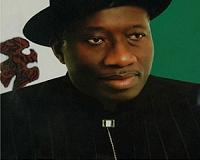
Nigeria's President Goodluck Jonathan on Wednesday called on his new military top brass not to disappoint the nation in their task to crush the Boko Haram insurgency.
He told the officers in Abuja that "the war against terror must be won in this country" and that he was convinced the government had selected "the right team to salvage this country at this time".
"You must not disappoint Nigerians," he said.
The previous chief of defence staff and the three heads of the army, navy and air force were dismissed on January 16, two days after a car bomb ripped through a market in Maiduguri, killing 19.
The capital of Borno state, in northeast Nigeria, was also targeted in early December last year, when Boko Haram fighters stormed military installations near the city's airport.
The fight against the Islamist group, deemed an international terrorist organisation by the United States, is Nigeria's most pressing security concern.
Thousands have died in Boko Haram attacks against schools teaching a "Western" curriculum, churches and elsewhere as well as in the counter-insurgency operations by the military.
A state of emergency imposed in Borno and two other northeastern states in May has seen attacks reduced in towns and cities, but violence is still frequent in more remote, rural areas.
Nigeria's new chief of defence staff, Air Marshal Alex Badeh, said on January 20 that the violence "must be brought to a complete stop before April 2014".
The defence ministry said on Tuesday that Badeh's remarks should not be interpreted as a literal deadline.
Push to oust Algeria intel chief deepens ruling party split
Algiers (AFP) Feb 05, 2014 –
A call by the head of Algeria's National Liberation Front (FLN) for the military intelligence chief to step down has deepened a split in the ruling party just months before a presidential election.
In an interview published Monday, FLN leader Amar Saidani called on veteran DRS director General Mohamed "Tewfik" Mediene to surrender his long behind-the-scenes grip on political power.
But the rival wing of the ruling party hit back Wednesday, condemning the "dangerous statements" from the party leader "which arbitrarily targeted state institutions without any thought for the consequences."
The dissidents' leader, Abderhamane Belayat, who served as FLN interim leader between January last year and Saidani's election in August, said his supporters would no longer recognise him as FLN chief and would not consider themselves bound by his comments.
The open split comes ahead of an April election in which the party has chosen veteran President Abdelaziz Bouteflika as its candidate even though the ailing 76-year-old head of state has not indicated whether his health will permit him to stand for a fourth term.
Bouteflika reportedly took decisive steps last year to roll back the pervasive influence of the country's secretive military elite which has dominated the political scene since independence.
He moved to curb the prerogatives of the DRS, which analysts said strengthened his hand in his long-running power struggle with the military, ahead of the elections.
But public criticism by senior officials of the man at the head of the intelligence agency since 1990 is very rare.
"If we examine the achievements of internal security in certain important cases, we can see that the agency's failures have multiplied," Saidani told independent news website Tout sur l'Algerie.
"In my opinion, Tewfik should have resigned after these failures," added Saidani, using the name by which General Mediene is commonly known in Algeria.
"The presence of internal security in every institution gives the impression that power in Algeria is not in civilian hands," Saidani said.
"Instead of managing the country's security, this department (the DRS) interferes with the activities of political parties, the judiciary and the press," he added.
Saidani was controversially elected FLN secretary general in August last year, amid strong opposition from some within the ruling party, just a month before Bouteflika reportedly curtailed the powers of the DRS.
Three of the agency's key units — the army communications bureau, its central security office and its judicial police force — where placed under the control of General Ahmed Gaid Salah, a close Bouteflika ally, according to local press reports that have not been denied.
