
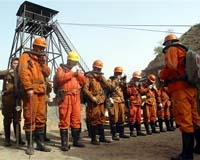
Zhang Fucheng has lost count of how many hellish scenes he has plunged into in 35 years as a China mine rescue worker, but he is certain of one thing — this weekend's deadly blast was the worst.
"This is the most serious I have encountered," the 56-year-old Zhang said, lighting a cigarette as he took a rare break in an office of the Xinxing coal mine in the city of Hegang in northeastern China's Heilongjiang province.
That means a lot coming from Zhang, one of the unsung rescue heroes who perform the dirty, dangerous — and depressingly steady — work of rescuing Chinese miners from cave-ins, mine shaft floods, and gas explosions.
Zhang has directed the rescue effort in Hegang, where a gas blast tore through the Xinxing mine on Saturday, killing 107 workers and leaving one missing.
He said he had slept for just one of the previous 50 hours as the frantic search effort was launched, but that's not unusual for Zhang, who heads the Hegang branch of the national mine rescue department.
Zhang was on the scene of the explosion soon after it happened, and went down the shaft with other rescuers to pull out survivors — and corpses.
"It's hard to describe (what I saw). Where the explosion was really powerful, mining carts were deformed, twisted, the beams were also deformed," he said.
"Some people lost their arms, others their legs."
China's coal mines are among the world's most deadly, and the Hegang disaster has reignited concern over safety and working conditions in the mining sector.
Media reports have quoted the deputy head of the state work safety agency as saying overcrowded shafts were among the factors in the disaster.
Zhang, however, said the explosion was "very sudden" and hard to avoid.
He acknowledged the risks he ran for his job, which pays him just over 2,000 yuan (300 dollars) a month — a co-worker was killed in a blast on a rescue mission in the late 1980s.
"When I first started rescue work, it was really scary. It was like being a surgeon when you first see blood," he recalled.
"I used to have nightmares. I'd wake up with a start. But now, they've stopped."
Tall and stocky, Zhang began work as a junior rescuer at the age of 21, when China was still desperately poor and work safety standards even worse than today.
He said mining accidents were commonplace then, but that the situation has improved in the past four years.
Authorities in recent years launched a nationwide campaign to close unsafe and illegal mines and say thousands have been shut.
"Safety has gradually improved. There used to be a lot of accidents in Hegang," he said.
"If you look at the news, there are a lot of accidents (in China) but the overall rate of accidents has actually gone down," Zhang said.
Official figures say more than 3,200 workers died in coal mines in 2008, down from previous years. But independent labour groups say many more deaths are covered up.
Lighting another cigarette, Zhang, who refreshes his rescue skills at an annual training session in Beijing, described a few tight moments in his career.
Once as a rookie on the job, the tube supplying him with oxygen stopped working as he was underground. He fainted, but fellow rescuers managed to get him out.
The Hegang disaster posed its share of dangers to rescuers as well but the work had to go on, he said.
For example, following initial reports of gas leak in the mine, a team of 10 of his rescue workers was dispatched to the scene. They were about to open a door leading down a mine shaft when the blast ripped through the tunnels.
"The force of the blast tore off their helmets and their clothes," Zhang said.
"But they were not scared. They cleaned themselves up and then went down the mine through another entrance."
Share This Article With Planet Earth
