
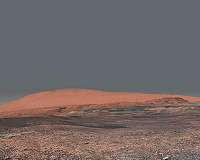
This mosaic, taken by the Mars Curiosity rover, looks uphill at Mount Sharp. Spanning the center of the image is an area with clay-bearing rocks that scientists are eager to explore; it could shed additional light on the role of water in creating the landscape.
The mosaic was assembled from dozens of images taken by Curiosity's Mast Camera (Mastcam). It was taken on Sol 1931 in January 2018.
Mount Sharp stands in the middle of Gale Crater, which is 96 miles (154 kilometers) in diameter. This mound, which Curiosity has been climbing since 2014, likely formed in the presence of water at various points of time in Mars' ancient history.
That makes it an ideal place to study how water influenced the habitability of Mars billions of years ago.
The scene has been white-balanced so the colors of the rock materials resemble how they would appear under daytime lighting conditions on Earth.
Extensive Study of Rock Target 'Aguas Calientes'
Opportunity is continuing the exploration of "Perseverance Valley" on the west rim of Endeavour Crater.
The rover is positioned about half way down the approximately 656 feet (200-meter) valley.
Opportunity is engaged in an extensive in-situ (contact) science campaign on the surface target called "Aguas Calientes," an exposed rock outcrop. After previously brushing the surface, on Sol 5026 (March 14, 2018), the rover used the robotic arm (IDD) to collect a Microscopic Imager (MI) mosaic of the freshly brushed target and then placed the Alpha Particle X-ray Spectrometer (APXS) on the target for a multi-hour integration.
A Navigation Camera (Navcam) panorama was also collected. Then, on Sol 5027 (March 15, 2018), the Rock Abrasion Tool (RAT) was used to grind into the target approximately 2 millimeters.
This was followed by brushing to remove the grind tailings. On Sol 5028 (March 16, 2018), another MI mosaic was collected of the ground target and the APXS was placed for another multi-hour integration. Over the next three sols, both Panoramic Camera (Pancam) and Navcam imagery were collected while the APXS integrated on the ground surface target.
On Sol 5032 (March 20, 2018), "Aguas Calientes" was ground even deeper by the RAT, penetrating another 2 millimeters into the rock outcrop. Again, the target was brushed clean after the grind. The plan ahead is more imaging of the deeper grind and another APXS placement into the deeper hole.
As of Sol 5032 (March 20, 2018), the solar array energy production was 664 watt-hours with an atmospheric opacity (Tau) of 0.520 and an improved solar array dust factor of 0.842.
Total odometry is 28.04 miles (45.12 kilometers).
