
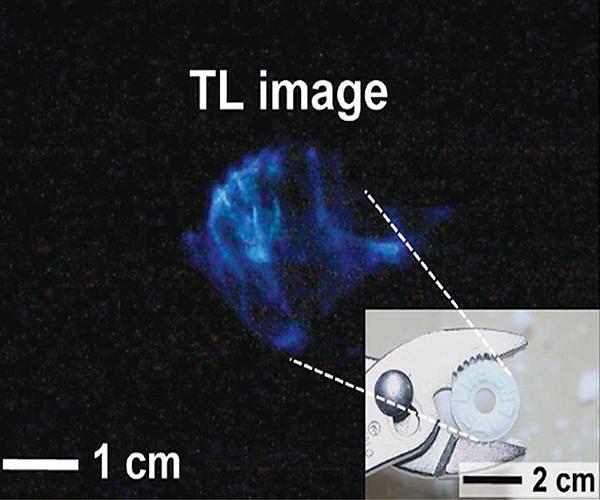
Researchers at the Okinawa Institute of Science and Technology (OIST) Graduate University have demonstrated mechanoluminescence in non-crystalline materials, challenging the common belief that crystals are required for this phenomenon. Mechanoluminescence, the emission of light by materials subjected to mechanical action, has traditionally relied on rigid crystalline systems, which lose their properties as they fragment.
Professor Julia Khusnutdinova and her team investigated a series of chemical compounds known for their photoluminescent capabilities. The researchers fabricated thin, flexible films without crystals and subjected them to different mechanical stimuli such as contact-separation and friction. Their experiments showed that mechanical stimulation generated localized electric fields through electrification, exciting the materials and surrounding gas. When protected by a plastic layer, the films produced mechanoluminescence without being damaged.
Dr Ayumu Karimata, first author of the study, stated, "Traditionally, chemists have thought crystal fracture an essential step in generating mechanoluminescence. We have proved that's not necessary. Our findings open up a vast array of possibilities in materials science, as they remove the need for complex crystal design and engineering when creating mechanoluminescent materials."
The discovery supports future development of stimuli-responsive materials for industrial engineering and safety, using longer-lasting, non-crystalline films.
