
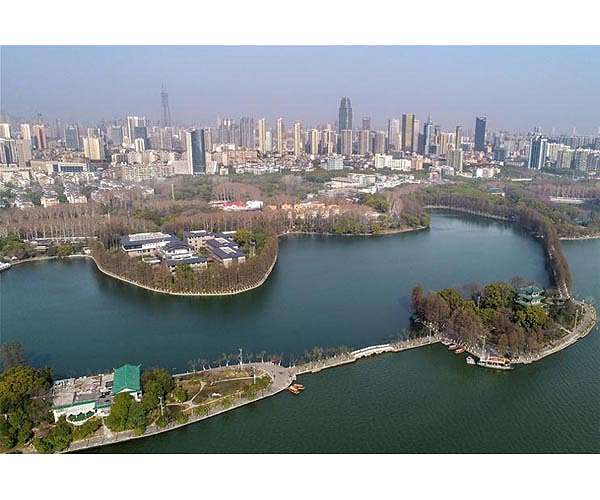
Authorities in China's Wuhan said Tuesday they would test the city's entire population for Covid-19, as the virus returned to the place where it first emerged and the highly contagious Delta variant drove tightening lockdowns worldwide.
A resurgent virus has returned with a vengeance, buoyed by stalling vaccination rates and deadly new mutations even in places which had long touted their successes in overcoming the worst of the pandemic.
China brought domestic cases down to virtually zero after the coronavirus first emerged in Wuhan, allowing the economy to rebound and life to return largely to normal.
But a fresh outbreak has thrown that record into jeopardy, as the fast-spreading Delta variant reaches dozens of cities after infections among airport cleaners in Nanjing sparked a chain of cases that have been reported across the country.
In Wuhan — where the virus first emerged in December 2019 and which faced a gruelling lockdown in the early months of the pandemic — authorities said they were launching a mass-testing program for all 11 million residents.
And across China, authorities have confined the residents of entire cities to their homes, cut domestic transport links and rolled out mass testing in recent days as the country battles its largest coronavirus outbreak in months.
Millions are also still under movement restrictions in Australia, where troops Monday hit the streets of the country's largest city of Sydney and surrounding areas, which are entering the sixth week of a lockdown set to run until the end of August.
Authorities have been struggling to stop the spread of the highly infectious Delta variant in the city — and to ensure that residents follow containment rules — with more than 3,600 cases recorded since mid-June.
With about 15 percent of Australia's 25 million people fully vaccinated, authorities are still relying on lockdowns to slow the spread of the virus.
– Hospitalisations in the US –
And the virus has even spread in places where inoculation rollout programs have been relatively successful, with the United States seeing a new wave driven by the Delta variant that has sent hospitalisations soaring to levels not seen since last summer.
The country on Monday hit President Joe Biden's goal of administering at least one jab to 70 percent of adults one month late — dashing hopes of declaring victory over the worst of the pandemic by Independence Day on July 4.
Officials blamed falling vaccine rates, particularly in areas where hesitancy is higher as well as among younger people, those with lower income and racial minorities, for the missed deadline as well as the soaring caseload.
"These cases are concentrated in communities with lower vaccination rates," Jeff Zients, White House Covid task force coordinator, told reporters.
"One in three cases nationwide occurred in Florida and Texas this past week," he added.
In a silver lining, US states that lagged behind in their vaccination rates are belatedly catching up, according to the latest data.
And faced with the Delta variant, other countries have begun considering a rollout of booster shots, which some drug manufacturers have suggested could enhance immunity to more infectious mutations of the virus.
Germany said Monday that it would begin offering third jabs to elderly and at-risk groups, citing concerns over "a reduced or rapidly declining immune response" among some people.
A booster shot will also be offered to anyone who received the two-dose AstraZeneca or single-dose Johnson & Johnson vaccines, a document released by the country's health ministry said, "in the interests of preventative healthcare".
Hong Kong announces compulsory vaccines for key sectors
Hong Kong (AFP) Aug 2, 2021 –
Hong Kong civil servants, teachers and healthcare workers must get vaccinated against the coronavirus or pay for regular testing, the city's leader announced Monday, as her administration adopted a push into mandatory inoculations.
The finance hub is one of the few places in the world to have secured ample supplies of the coronavirus vaccine, but public take up has been lacklustre.
After six months, only 36 percent of the city's 7.5 million residents are fully vaccinated with two jabs while 48 percent have received one dose.
But infections have remained low as Hong Kong has been all but closed to non-residents for most of the last 18 months and all arrivals must undergo lengthy quarantine in designated hotels.
On Monday, chief executive Carrie Lam announced a new push to raise the city's vaccination rate by making jabs compulsory for four sectors: civil servants, healthcare workers, care home staff and school teachers.
Vaccination rates vary between those sectors — from 70 percent among civil servants to just 47 percent among teachers.
"There is much room for improvement," Lam said.
Those who refuse vaccinations will have to be tested twice a week and pay for the cost out of their own pocketsunless they have a valid medical reason not to be inoculated.
"If people are refusing to get vaccinated for reasons that are not health related, I don't think a responsible government should tolerate that," Lam said.
The city's virus measures have kept infections down with around 12,000 cases and 200 deaths. No local infections have been recorded for more than 50 days.
But the zero Covid strategy has imposed tough economic costs on the city, once a major international transport hub, and added to a sense of complacency among the public.
Swirling distrust of the government as authorities carry out a sweeping crackdown on dissent has also compounded poor vaccine take up.
Steered by Beijing, Hong Kong's government has swung authoritarian in response to huge and often violent democracy protests two years ago.
Public gatherings and protests have been banned throughout the pandemic while scores of critics have been jailed.
Wearing masks in public is compulsory. But until now, Lam's administration stayed away from doing the same for vaccines.
Relations with some of the sectors affected by Monday's announcement are also tense.
The mandatory vaccines for teachers come two days after the government said it was severing all ties with the city's largest teaching union because its members supported the democracy movement.
Healthcare workers also played a key role in 2019's democracy protests.
