
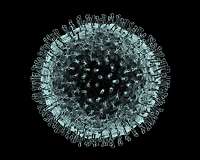
According to new research, the novel coronavirus can remain in the air for up to 3 hours and survive on some surfaces for two to three days.
The research, which was carried out by scientists from the National Institutes of Health, Princeton University and UCLA, suggests it's possible for the virus to spread through the air as well as through the touching of contaminated surfaces.
"Our results indicate that aerosol and fomite transmission of HCoV-19 is plausible, as the virus can remain viable in aerosols for multiple hours and on surfaces up to days," researchers wrote in the study's abstract.
The research was published on medRxiv, a site where health and medical science studies can be shared prior to peer review and acceptance into a scientific journal.
For the study, scientists used a nebulizer to spray the coronavirus into the air in a manner similar to a cough. The virus could be detected in the air up to 3 hours later. Researchers also placed samples on a variety of surfaces. They found the virus could survive for up to 4 hours on copper, as many as 24 hours on cardboard, and two to three days on plastic and stainless steel.
Tests showed the genetically related virus responsible for the 2003 SARS outbreak is similarly durable, so the ability of the new coronavirus to survive in the air and on surfaces doesn't explain its ability to spread more rapidly.
"Overall, stability is very similar between HCoV-19 and SARS-CoV-1," researchers wrote.
The study is one of the first to look specifically at how long the new coronavirus can live in the air and on surfaces, but it doesn't prove how exactly COVID-19 is spreading.
"We don't know if you can pick up COVID-19 from contaminated surfaces or inanimate objects at this point. That's the bottom line," Marilyn Roberts, a microbiologist at the University of Washington School of Public Health, told the MIT Technology Review.
The new coronavirus can be killed using a range of disinfectants, including rubbing alcohol and diluted hydrogen peroxide. The Environmental Protection Agency has a complete list of the commercially available cleaning products that can kill the virus.
An earlier survey of the available scientific literature on the complete family of coronaviruses — SARS coronavirus, the Middle East Respiratory Syndrome coronavirus and endemic human coronaviruses — showed some of the viruses can can persist on inanimate surfaces such as metal, glass and plastic for up to nine days.
No, coronavirus isn't the same as the flu
Paris (AFP) March 11, 2020 –
Aches and pains, sore throat, fever — although they may feel similar to those suffering from their symptoms, the novel coronavirus is not the same as the seasonal flu, experts stressed Wednesday.
– Mortality –
COVID-19, the illness caused by coronavirus, proves deadly in around 3.5 percent of confirmed cases.
While this is not the same as its mortality rate, given many people may be infected but not realise it, it is significantly higher than seasonal flu, which typically kills 0.1 percent of patients.
"There is still considerable uncertainty around the fatality rates of COVID-19 and it likely varies depending on the quality of local healthcare," said Francois Balloux, Professor of Computational Systems Biology at University College London.
"That said, it is around two percent on average, which is about 20 times higher than for the seasonal flu lineages currently in circulation."
– Serious cases –
But the true danger of coronavirus is unlikely to be the death toll. Experts say health systems could easily become overwhelmed by the number of cases requiring hospitalisation — and, often ventilation to support breathing.
An analysis of 45,000 confirmed cases in China, where the epidemic originated, show that the vast majority of deaths were among the elderly (14.8 percent mortality among over 80s).
But another Chinese study showed that 41 percent of serious cases occurred among under 50s, compared with 27 percent among over 65s.
"It's true that if you're older you're at greater risk, but serious cases can also happen in relatively young people with no prior conditions," said French deputy health minister Jerome Salomon.
– Contagiousness –
Disease experts estimate that each COVID-19 sufferer infects between two to 3 others.
That's a reproduction rate up to twice as high as seasonal flu, which typically infects 1.3 new people for each patient.
– Vaccine/treatment –
Salomon said that humans have lived with influenza for more than 100 years.
"We've studied it closely," he said. "This new virus resembles the flu in terms of physical symptoms but there are huge differences."
Number one is the lack of a vaccine against COVID-19, or even any treatment shown to be consistently effective.
While some trials have shown promise delivering anti-retroviral drugs to serious cases, as well as some experimental therapies, their sample sizes are too small to roll out to the general population.
Hundreds of researchers around the world are working frantically to find a COVID-19 vaccine, but the development process takes months and is likely too late for the current outbreak.
Even if a vaccine magically appeared, getting everyone access it to it is no small order. Health authorities regularly complain that not enough people receive the flu vaccine to guarantee "herd immunity".
– Similarities –
But the new virus does share some characteristics with flu, notably the measures each one of us can personally take to slow the infection rate:
Avoid shaking hands, frequently wash your hands with soap and water, avoid touching your face and wear a mask if you are sick.
Such actions can limit new infections just as they can with the flu, gastro illnesses and other infectious diseases.
France's health ministry says that only two in 10 people regularly wash their hands after using the bathroom.
"And only 42 percent of people cover their mouth with an elbow or tissue when they cough or sneeze," it added, not encouragingly.
