
On Sol 1845 (April 2, 2009), the rover's robotic arm (IDD) placed the Mossbauer (MB) spectrometer on the outcrop target "Penrhyn" for a multi-sol integration. On Sol 1850 (April 7, 2009), a temporary stand-down on driving was provisionally lifted and Opportunity resumed driving. The MB was retracted and the arm moved into the driving stow position.
Opportunity then drove backward about 62.5 meters (205 feet). Diving backward was a continuation of mitigation techniques used in recent weeks in response to elevated current observed in the right-front wheel. The mitigation also has included resting the drive actuator for several sols, which coincided with the just-completed contact science campaign. The drive went well and the right-front actuator exhibited currents near normal levels, good news.
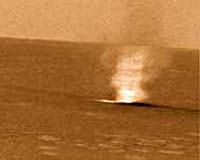
Opportunity also benefited from a solar array cleaning event which boosted energy levels by about 40 percent, a big increase. Now if only Spirit could get such a cleaning.
As of Sol 1850 (April 7, 2009), Opportunity's solar array energy production has increased to 515 watt-hours. Atmospheric opacity (tau) remains elevated at around 0.95. The dust factor has improved to 0.642, meaning that 64.2 percent of sunlight hitting the solar array penetrates the layer of accumulated dust on the array.
The rover is in good health with a rested actuator and extra energy.
As of Sol 1851 (April 8, 2009) Opportunity's total odometry is 15,113.97 meters (9.39 miles).
Opportunity Examining Rocky Outcrop
Opportunity remains positioned on an exposed rock outcrop and is continuing a contact science campaign with the robotic arm (IDD). On Sol 1838 (March 26, 2009), the rock abrasion tool (RAT) was operated for 3 hours to grind 3 millimeters (one-tenth of an inch) into the selected rock outcrop target. The grind, using the work-around for the failed encoder, worked as sequenced.
Documentary imagery was collected of the new RAT hole. Then the Moessbauer (MB) spectrometer was placed in the RAT hole for a long integration. On Sol 1840 (March 28, 2009), stereo imagery by the microscopic imager (MI) was collected and the MB positioned for further readings.
On Sol 1843 (March 31, 2009), after a few sols of MB integration, images documenting the MB placement on the RAT tailings were collected and then the alpha particle X-ray spectrometer (APXS) was placed on the target for its integration.
As of Sol 1843 (March 31, 2009), Opportunity's solar array energy production is 346 watt-hours, equivalent to the amount used by a 100-watt bulb lit for about three and a half hours. Atmospheric opacity (tau) remains elevated at 1.20.
The dust factor on the solar array has improved slightly to 0.512, meaning that 51.2 percent of sunlight hitting the solar array penetrates the layer of accumulated dust on the array. Both rovers are experiencing elevated atmospheric opacity as large storms to the south generate a lot of high-altitude dust.
Opportunity is in good health, with total odometry remaining at 15,051.44 meters (9.35 miles).
Share This Article With Planet Earth
