
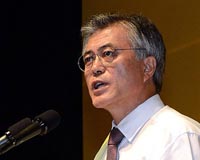
South Korean President Moon Jae-In will hold talks with Chinese leader Xi Jinping in Beijing on Thursday, seeking to repair a relationship strained over Seoul hosting a US missile system.
Moon's office has said he hopes to "normalise" ties during the visit, after Beijing was angered by the deployment of the Terminal High Altitude Area Defense (THAAD), installed earlier this year to protect South Korea against threats from the nuclear-armed North.
Beijing, which sees the system as a threat to its own security, then launched a series of measures against South Korean businesses and banned group tours to the South, in moves seen as economic retaliation.
The diplomatic spat took a major toll on many South Korean firms, most notably retail giant Lotte Group, which provided the land to host the powerful US missile system.
Angry boycott campaigns and regulatory crackdowns by Chinese authorities decimated its business in the world's second-largest economy, and it was forced to put its supermarket unit in China up for sale.
Moon has brought with him a business delegation that includes executives from Samsung, Hyundai and LG for the trip, which began Wednesday and is his first state visit to China since he took office in May.
"The visit is itself an important sign of the normalisation of bilateral relations," said Zhu Feng, international studies professor at Peking University.
Zhu said economic relations are getting back on track but that it is important for Moon's visit to take "the shadow of THAAD off the economy".
Last month the two countries issued identically-worded statements on their mutual desire to improve relations.
They did not state any specifics, but Beijing has demanded that Seoul formally promise not to deploy any more THAAD launchers and not to join any regional US missile defence system.
In one limited sign of improved ties, China's state tourism board approved Seoul-bound group tours from some parts of the country last month.
Chinese foreign ministry spokesman Lu Kang said on Tuesday that the two countries have reached "some consensus" on dealing with THAAD.
"We hope that the issue can continue to be handled properly and that the two sides can bring China-South Korea relations totally back to the track of sound and steady development," Lu said.
China has also urged the United States, Japan and South Korea to suspend joint military drills in the region in return for North Korea to halt its nuclear activities — an idea consistently rejected by Washington and Seoul.
Moon's visit comes after US Secretary of State Rex Tillerson said Washington was ready to talk to North Korea "without preconditions", though it remains determined to force Pyongyang to give up its nuclear arsenal.
Beijing has pressed for talks to peacefully resolve the crisis.
Russia welcomes 'constructive' US position on N. Korea talks
Moscow Dec 13, 2017 –
Russia on Wednesday said it welcomed US Secretary of State Rex Tillerson's statement that Washington is ready for talks with North Korea without preconditions, calling this a constructive approach.
"We can state that such constructive statements impress us far more than the confrontational rhetoric that we have heard up to now. Undoubtedly this can be welcomed," Kremlin spokesman Dmitry Peskov told journalists.
Peskov said that Washington's change of tone chimed with Russia's repeated calls for Washington to cool down its response to North Korea's nuclear weapons programme.
"This goes in the same direction as the calls from Russia," said Peskov, adding that President Vladimir Putin has regularly warned the US that "confrontational rhetoric and any steps that could provoke further tensions on the Korean peninsula are absolutely counterproductive."
"It was Putin who regularly and consistently called for all the parties involved to do all they could to set up channels for dialogue. Therefore, such statements (as Tillerson's) of course do give us satisfaction," the Kremlin spokesman said.
Asked if the US was grabbing the initiative from Russia, Peskov said that calming the situation was a shared aim and "no one can grab anything from any one else. The main thing here is succeeding in the task."
Russian deputy foreign minister Sergei Ryabkov said earlier Wednesday that Moscow did not need to put pressure on its Soviet-era ally and neighbour North Korea to participate in talks with Washington, since Pyongyang has said it is keen to do this.
"I don't think we need to influence North Korea in this direction, because Pyongyang has many times at different levels declared its readiness (for talks)," Ryabkov told journalists, quoted by RIA Novosti state news agency.
"Let's hope that after the statements coming from a high level in Washington, the opportunity for this will fall into place," he said.
US, S. Korea 'discuss' military drills amid Olympic worries
The US military is reportedly in talks with South Korea on the timing of large-scale annual military exercises that always infuriate nuclear-armed Pyongyang and could coincide with next year's Winter Olympics.
The Foal Eagle and Key Resolve drills usually start in late February or early March and involve tens of thousands of troops from the two allies, which say they are purely defensive. … read more
