
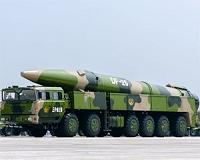
China's new 'carrier-killer' DF-26 missile is capable of going nuclear and more mobile, with the intent of becoming a deterrent against conflict in the South China Sea.
The DF-26 anti-ship ballistic missile was unveiled in September and has the capability to arm a nuclear warhead against an aircraft carrier, according to findings by researcher Andrew Erickson in the Chinese-language China Youth Daily newspaper.
Unlike its predecessor, the shorter-range DF-21D, the new missile allows for nuclear warheads to be mounted on it, which lets China use its limited nuclear potential against both strategic and tactical targets. The missile aims to change the power balance in the South China Sea, according to the newspaper.
"That 'change the warhead, not the missile' feature provides a rapid switch between nuclear and conventional," the Chinese article said.
Allowing for a mobile launch would also make China's nuclear potential more mobile, according to the article.
"But the DF-26 does not rely on a site for mobile launching. It can move fast, and it has no strict demands for where it is launched. So that is helpful to movement of missile forces all over and in concealment, and it is helpful to the rapid deployment, rapid launch, and rapid displacement of combat elements. "
According to the newspaper, the new missile aims to be preventative in the conflict China is involved in, regarding disputed islands in the South China Sea.
Chinese Submarine Rehearsed Attack on US Aircraft Carrier Reagan
With tensions high between Washington and Beijing, American defense officials claim that a Chinese submarine recently conducted a simulated cruise missile attack on the USS Reagan.
Earlier this year, details began to emerge about an incident in the Sea of Japan. After leaving port in Yokosuka on the weekend of October 24, the aircraft carrier USS Reagan reportedly came into close contact with a Chinese submarine.
According to the Washington Free Beacon, this was "the closest encounter" between a US aircraft carrier and a Chinese submersible in nearly a decade.
But according to US defense officials speaking to the Free Beacon, the encounter also involved that submarine locking onto the aircraft carrier as part of a simulated targeting exercise.
"If true, this would be yet another case of China trying to show us that they can hold our forces in the region at risk," Virginia Representative Randy Forbes, chairman of the House Armed Services subcommittee on sea power, told the Free Beacon.
"Coming on the heels of anti-satellite tests and other demonstrations, this latest incident should be a reminder of the destabilizing course that China is on and the challenges we face in maintaining a stable military balance in the Asia-Pacific region."
If true, such a maneuver could be a violation of the Code for Unplanned Encounters at Sea, also known as CUES. A section of that multinational agreement states that naval commanders should avoid actions what could result in mishaps. "Simulation of attacks by aiming guns, missiles, fire control radar, torpedo tubes or other weapons in the direction of vessels or aircraft encountered."
The Obama administration reportedly kept quiet about the incident for fear of further disrupting relations between the US and Chinese militaries. When asked directly, Pacific Command spokesman Capt. Darryn James instead assured reporters of the US Navy's capabilities.
"I cannot discuss submarine operations, reports of submarine operations, or rumors of submarine operations," he said, according to the Free Beacon. "I can tell you that we are completely confident in the effectiveness and capabilities of the ships and aircraft of the forward-deployed naval force."
The incident occurred only two days before the USS Lassen conducted provocative patrols through the South China Sea. That operation was meant to signal Washington's protest over Beijing's construction of artificial islands in the Spratly archipelago.
A highly contested region through which nearly $5 trillion in trade passes annually, China lays claim to most of the South China Sea, though there are overlapping claims by Malaysia, the Philippines, Vietnam, and Taiwan. While Washington has accused Beijing of attempted to establish an air defense zone in the region, China has maintained that it has every right to build within its own territory, and that the islands are mean primarily for humanitarian purposes.
On Monday, reports also surfaced that the US Navy is looking for ways to shore up its anti-ship missile systems, citing concerns of Chinese military prowess.
"You're going to lose ships and jets and people," David Ochmanek, a former senior Pentagon official, told Foreign Policy, referencing a hypothetical military showdown between the US and China. "Our military establishment came to this realization reluctantly. The challenge is as much conceptual as it is hardware related."
