
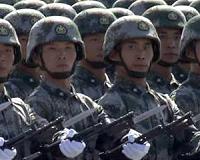
China's military has released a slick propaganda video showing a drill of armed troops quelling a protest in Hong Kong, as its commander for the city voiced determination to maintain law and order following two months of pro-democracy rallies.
The double-barrel signals on Wednesday were the strongest public interventions from China's armed forces into the crisis, which has seen masses of people take to the global financial hub's streets to demand more freedoms.
The video, posted online by the People's Liberation Army's (PLA's) garrison in Hong Kong, shows tanks, helicopters, rocket launchers and heavily armed troops in action across various locations of the semi-autonomous Chinese city.
The three-minute clip also specifically features an "anti-riot" drill in which soldiers with assault rifles, armoured personnel carriers and water cannons disperse a crowd of protesters in Hong Kong.
"All consequences are at your own risk," a soldier yells into a loudspeaker at the start of the drill in Cantonese, the language spoken in Hong Kong rather than the Mandarin of mainland China.
PLA troops are then seen wearing helmets, carrying long shields, marching with batons, laying out barbed-wire barricades and pointing the rifles.
An officer is also filmed holding a red flag that reads: "Warning, stop charging or we use force". The flag has the same words as ones that Hong Kong's police have used when confronting the pro-democracy protesters.
The drill ends with armed troops escorting protesters, who have their arms tied behind their backs, to areas designated by banners as "detention points".
– Rising anger –
The release of the video came on the same day dozens of people appeared in court in Hong Kong after being charged with "rioting" for their alleged involvement in a protest over the weekend.
The protests were sparked by anger over a government effort to introduce a law that would have allowed extraditions to mainland China.
Hong Kong's government suspended efforts to push that bill through parliament.
But the protests evolved into a people power movement demanding wide-ranging democratic reforms, in the most significant challenge to Beijing's rule since the city's handover from Britain in 1997.
Under the terms of the handover deal, people in Hong Kong enjoys rights and liberties unseen on the mainland, including an independent judiciary and freedom of speech.
But many say those rights are being curtailed, citing the disappearance into mainland custody of dissident booksellers, the disqualification of prominent politicians and the jailing of pro-democracy protest leaders.
Beijing had largely left the city's government to deal with the unrest.
But, with violence escalating over the past two weeks and the movement showing no signs of fading, it has sent louder signals that it could intervene.
– 'Definitely intolerable' –
In rare public comments, Chen Daoxiang, the commander of PLA's Hong Kong garrison, added his voice to the warnings while speaking at a reception on Wednesday night to celebrate the 92nd anniversary of the PLA.
"A series of extreme violent incidents have happened in Hong Kong that has severely damaged Hong Kong's prosperity and stability and seriously challenged Hong Kong's rule of law and social order," Chen said.
With Hong Kong Chief Executive Carry Lam in the audience, Chen described the unrest as "definitely intolerable".
"We firmly support the action to maintain Hong Kong's rule of law by the people who love the nation and the city, and we are determined to protect the national sovereignty, security, stability and the prosperity of Hong Kong," he said.
Thousands of PLA troops have been based at the Hong Kong garrison since the handover, but they generally keep a low profile and are rarely seen in uniform in public.
Hong Kong's law states that the PLA troops stationed in Hong Kong "shall not interfere in the local affairs of the region".
But it does allow the PLA troops to be deployed in Hong Kong at the request of the Hong Kong government to "maintain public order".
Pro-democracy lawmaker Claudia Mo said the PLA's video was an "obvious threat" against Hong Kong's protesters.
"But it just might add fuel to fire, making the young even more angry, " Mo told AFP.
Tensions high as Hong Kong pro-democracy protesters face court
Hong Kong (AFP) July 31, 2019 –
Dozens of Hong Kong pro-democracy protesters appeared in court Wednesday after being charged with rioting, setting the stage for further unrest in a weeks-long crisis that has rocked the global financial hub.
The announcement on Tuesday night that 44 people had been charged with rioting — an offence that carries a jail term of up to 10 years — immediately triggered another round of clashes between police and protesters.
Supporters continued to voice their outrage as they stood for hours on Wednesday outside court, braving heavy winds and rain, as the accused rioters appeared before a judge.
"Release the righteous… no rioters, only tyranny… reclaim Hong Kong, the revolution of our times," the supporters chanted.
The protesters were generally calm as they took turns to appear in front of the judge, who formally read the charges and granted them bail.
The range of their professions reflected the wide support across Hong Kong society for the pro-democracy movement.
They included a teacher, a nurse, an airline pilot, a barber, a chef, an electrician, a construction worker and unemployed people, according to their charge sheets.
A 16-year-old girl was also among the group.
– Protest evolution –
Semi-autonomous Hong Kong has endured more than seven weeks of unrest that began with a government bid to introduce a law that would have allowed extraditions to mainland China.
The protests evolved into a movement for deeper democratic reforms and an end to eroding freedoms, in the most significant challenge to Beijing's rule since the city's handover from Britain in 1997.
In the latest confrontation, police used pepper spray and batons against hundreds of protesters who had gathered outside a police station in solidarity with those who had just been charged.
Footage broadcast live on television showed an officer aiming a shotgun at protesters who were throwing objects at him.
Police said on Wednesday evening they had arrested three people after fireworks were fired from a car at protesters gathered outside another police station on Tuesday night.
The previous two weekends had seen a surge in the level of violence used by both protesters and police, who repeatedly fired rubber bullets and tear gas to disperse projectile-throwing crowds.
A mob of pro-government thugs also attacked protesters, putting 45 people in hospital.
The 44 protesters were charged for their alleged role in running battles between police and protesters in a well-heeled residential neighbourhood on the main island on Sunday.
The move to charge protesters with rioting came a day after Beijing publicly threw its weight behind Hong Kong's leader Carrie Lam and the police, saying violent protesters must be swiftly punished.
"No civilised society or rule of law society will tolerate rampant violence," Yang Guang, spokesman for the cabinet-level Hong Kong and Macau Affairs Office, told reporters.
But while Beijing has issued increasingly shrill condemnations of the protests, it has left the city's government to deal with the situation.
Lam has shown no sign of backing down beyond agreeing to suspend the extradition bill, and has made few public appearances.
Amnesty International said the charging of the 44 protesters with rioting was aimed at intimidating others from taking part in future pro-democracy rallies.
"By using such vague charges against pro-democracy protesters, the Hong Kong authorities seem intent on sending a chilling warning to anyone considering taking part in future protests," the global human rights group's Hong Kong director, Man-kei Tam, said in a statement.
But protesters have vowed to keep their campaign going until their core demands are met.
They include Lam's resignation, an independent inquiry into police tactics, an amnesty for those arrested, a permanent withdrawal of the bill and the right to elect their leaders.
Under the terms of the 1997 handover deal from British to Chinese rule, Hong Kong enjoys rights and liberties unseen on the mainland, including an independent judiciary and freedom of speech.
But many say those rights are being curtailed, citing the disappearance into mainland custody of dissident booksellers, the disqualification of prominent politicians and the jailing of pro-democracy protest leaders.
Public anger has been compounded by rising inequality, the high costs of living and the perception that the city's distinct language and culture are being threatened by ever closer integration with the Chinese mainland.
