
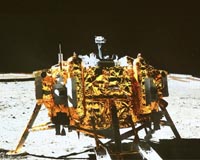
While the world awaits the awakening of China's Yutu Moon rover at the end of this long lunar night, let's not forget that Yutu is not the only spacecraft on the Moon. Yutu was delivered to the lunar surface aboard Chang'e-3, a large robot lander. Chang'e-3 is the first Chinese spacecraft to make a soft landing on the Moon. It follows in the wake of China's first two lunar missions, which orbited the Moon.
Chang'e-3 is a boxy, flat spacecraft that resembles the lower stage of an Apollo lunar module. It is designed to serve as a multipurpose spacecraft that will carry other objects to the Moon besides small rovers.
The basic design of the lander will be used as a part of a lunar sample-return mission later this decade. Eventually, this lander could eventually evolve into a spacecraft capable of landing Chinese astronauts on the Moon.
Chang'e-3 also sleeps during the lunar night, but it is expected to work again when the sun rises. It has scientific instruments that are different from those found on the Yutu rover.
The most interesting payload on Chang'e-3 is an ultraviolet telescope that has been used to observe distant stars and the Earth itself. Chang'e-3 also has a camera mast that returned panoramic images of the landing site. This camera no longer operates, but it was not expected to survive for an extended period.
The scientific value of the Yutu rover has been compromised by the fact that is can no longer move. Most of the scientific instruments on Yutu are designed to be taken to different locations and investigate things close to the rover.
Now, they can only probe a small area close to the rover.
By contrast, the Chang'e-3 lander carries scientific instruments that were not designed to move around. The lander was always intended to remain in one spot after touchdown. Thus, its scientific results could ultimately prove to be more bountiful than the rover, assuming that Chang'e-3 continues to function for an extended period.
The Chang'e-3 spacecraft is more than just a landing stage. It was also responsible for navigating itself across cislunar space between the Earth and Moon, entering orbit around the Moon, then descending.
Thus, Chang'e-3 had already accomplished several important tasks before it even reached the lunar surface. Its ongoing functionality suggests that the lander has been very successful in its operations, despite the well-known problems with the Yutu rover. On balance, that makes the whole mission seem more successful than some critics may think.
