
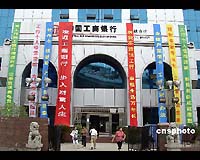
China's biggest bank ICBC on Thursday announced mounting problem loans, after International Monetary Fund staff argued that the world's second-biggest economy needs a more "comprehensive" plan to tackle bad debts.
The Industrial and Commercial Bank of China (ICBC), believed to be the world's largest bank by assets, said its non-performing loan ratio rose to 1.66 percent at the end of March, up from 1.50 percent at the end of last year.
Its first-quarter net profits rose just 0.59 percent year-on-year to 74.76 billion yuan ($11.51 billion), according to a statement to the Hong Kong stock exchange.
China is considering both converting non-performing loans into equity, and repackaging bad loans into securities which could then be sold, according to media reports which have not been confirmed by the government.
"While such techniques can play a role in addressing these problems and have been used successfully by other countries, they are not comprehensive solutions by themselves," three IMF staff members said in a blog post accompanying a research report released earlier this week.
"Unless they are carefully designed and part of a sound overall framework, they could actually worsen the problem," they said, adding one issue was allowing so-called "zombie" companies to survive.
China's "Big Four" banks are scheduled to report first quarter results this week.
The Bank of China, the main foreign exchange bank, said Tuesday that it had non-performing loans of 135.83 billion yuan at the end of March, accounting for 1.43 percent of the total — steady from the end of 2015.
Its net profit rose only 1.70 percent year-on-year in the first quarter to 46.62 billion yuan, according to a statement.
The IMF posting said that to tackle bad loans, China should shut down distressed firms and require banks to be more proactive.
"To help address the systemic problem of excessive corporate debt and impaired bank loans more generally, they need to be part of a comprehensive, system-wide plan," it said.
China's HNA to buy Carlson Hotels in acquisition binge
Shanghai (AFP) April 28, 2016 –
Chinese conglomerate HNA will buy US-based Carlson Hotels, owner of the Radisson brand, the companies announced, as it looks to build its presence in the American market.
It is the third overseas acquisition announced by HNA in as many months and the latest in a long line of foreign forays by cashed up Chinese companies.
It also comes after a failed $14 billion bid by another Chinese company, financial conglomerate Anbang, to buy Starwood Hotels.
HNA Tourism Group has agreed to buy Carlson Hotels, including its majority 51.3 percent stake in Brussels-based Rezidor Hotel Group, from parent company Carlson Hospitality Group, a joint statement said.
Financial terms were not disclosed.
Carlson, headquartered in Minnesota, has 1,400 hotels in operation and under development in 115 countries and territories. Rezidor is its master licensee with hotels in Europe, the Middle East and Africa.
HNA Hospitality Group chairman and chief executive officer Bai Haibo said in the statement the acquisition aimed to "establish our presence in the US market and expand our footprint in hospitality internationally".
HNA is best known as a parent of Hainan Airlines but it also has interests in tourism, hotels, financial services and real estate.
In February, HNA bought US technology distributor Ingram Micro for $6.0 billion and earlier this month it made a $1.5 billion offer for Swiss airline catering company Gategroup.
Its latest transaction has been approved by the Carlson board and is expected to close in the second half of this year, said the statement, posted on Carlson's website Wednesday.
HNA must decide whether to launch a mandatory public tender offer for the remaining shares in Rezidor or sell down its ownership to below 30 percent, the companies added.
China has encouraged its domestic firms to look overseas for deals that improve their balance sheets and strengthen their operations as the economy slows at home.
State-owned China National Chemical Corp. (ChemChina) in February offered $43 billion for Swiss pesticide and seed giant Syngenta, which will be the biggest-ever overseas acquisition by a Chinese firm if completed.
