
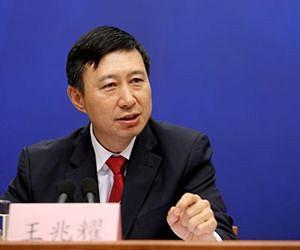
China will endeavor unremittingly in its pursuit of manned space technology, a senior space program official said Friday at a press briefing detailing the nation's first-ever space docking.
On Thursday China successfully landed the unmanned spacecraft Shenzhou-8, which docked twice with the space lab module Tiangong-1.
Wang Zhaoyao, deputy director of China's manned space program office, said it marks a major breakthrough for China's space rendezvous and docking technology, and a milestone event in the nation's manned space development program.
However, Wang said, "It's still too early to say China has mature space technology, and the success of one or two missions cannot change the international aerospace landscape that has been shaped for years."
Wang said China has mastered three basic technologies of manned space flight through Shenzhou-8 and previous missions of the Shenzhou series, including manned ground-space transportation, extravehicular activity, and docking technology.
These three basic technologies have laid a sound foundation for us to build manned space station and carry out large scale space application projects, Wang added.
The space lab module Tiangong-1, which blasted off into space on Sept. 29, will remain in orbit to await docking attempts by both Shenzhou-9 and Shenzhou-10 spacecraft in 2012. At least one of the two space vessels will take astronauts.
Wang said he and his colleagues were confident that Tiangong-1 would function until the end of its design life of two years.
"Monitoring data show that all the systems of Tiangong-1 are in perfect condition, so we are quite confident that it will work till next year and the end of its design life," he said.
Furthermore, when asked to comment on the mission's military implications, Wang said China's space missions have not included any programs that directly serve defense purposes.
However, space-related technological developments can be used in both civilian and military sectors, he said.
"For example, a communication satellite can be used for TV broadcasting and military communication," he said.
In response to comments that China's space missions have lacked transparency, Wang said the country has made great efforts to introduce its missions to the outside world and will continue to cooperate with other countries under the principle of mutual respect, mutual benefit and transparency.
Space missions not directly linked to defense: China
China's space missions have not included any programs that directly serve defense purposes, a senior space program official said Friday.
However, space-related technological developments can be used in both civilian and military sectors, Wang Zhaoyao, vice director of the China Manned Space Engineering Office, said at a press conference.
"For example, a communication satellite can be used for TV broadcasting and military communication," he said.
In response to comments that China's space missions have lacked transparency, Wang said the country has made great efforts to introduce its missions to the outside world and will continue to cooperate with other countries under the principle of mutual respect, mutual benefit and transparency.
China completed its first-ever space docking mission Thursday after the successful landing of the unmanned spacecraft Shenzhou-8, which docked twice with the space lab module Tiangong-1 during its 17-day mission.
China confident in functioning of space lab module Tiangong-1
An official from China's manned space program said Friday they were confident that space lab module Tiangong-1 would function until the end of its design life of two years.
Tiangong-1 remains in orbit after its involvement in the country's first-ever space docking mission with another unmanned spacecraft this month.
"Monitoring data show that all the systems of Tiangong-1 are in perfect condition, so we are quite confident that it will work till next year and the end of its design life," said Wang Zhaoyao, deputy director of China's manned space program office, at a press conference on the docking mission of Tiangong-1 and unmanned spacecraft Shenzhou-8.
Tiangong-1, which blasted off into space on Sept. 29, will remain in orbit to await docking attempts by both Shenzhou-9 and Shenzhou-10 in 2012.
At least one of the two space vessels will take astronauts.
Source: Source: Xinhua
