
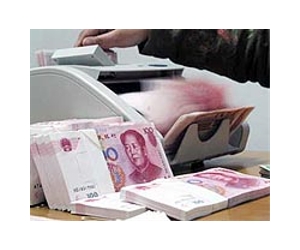
China said Saturday it was opposed to political interference in its exchange rate mechanism, amid growing international pressure for policymakers to let the yuan appreciate.
"Sometimes, the exchange rate issue can be politicised. We are opposed to this practice," central bank governor Zhou Xiaochuan told reporters on the second day of the National People's Congress, the annual parliamentary session.
The value of the Chinese currency, which has effectively been pegged to the US dollar since mid-2008, has been a bone of contention between Beijing and its Western trading partners, which say it is kept low to boost exports.
China has said maintaining a stable currency is a "top priority" and is needed for the survival of Chinese companies and jobs growth in the world's third-largest economy, as export markets slowly recover from the crisis.
But as the nation powers out of the global crisis — its economy grew by 10.7 percent in the fourth quarter of 2009 after a massive public spending programme — there is a growing clamour for the value of the yuan to appreciate.
Defending the controversial exchange rate policy, Zhou said China faced "many uncertainties" and the timing of a return to "normal" policies was a complex issue.
"Although we have seen signs of recovery the impact of the financial crisis is still very keenly felt," Zhou said.
"Sooner or later we will withdraw economic stimulus policies (but) we need to be cautious in choosing the timing of the exit."
Beijing blasts US penalties on Chinese potassium, paper
Beijing (AFP) March 5, 2010 –
Beijing on Friday slammed fresh US sanctions on Chinese exports of certain potassium salts and coated paper as "discriminative", amid growing tensions between the two sides.
The US Commerce Department said earlier this week it would slap preliminary duties — a whopping 109 percent on potassium salts and up to 13 percent on coated paper — to offset Chinese government subsidies.
China's commerce ministry spokesman Yao Jian said these were "discriminative" measures aimed to "unfairly restrict the normal exports of China-made products."
Potassium salts are used in industrial cleaning products, fertilizers and food additives while coated paper is used in printing of corporate annual reports and high-end catalogues and magazines.
"The root cause of the difficulties US coated paper and other industries are now facing is the slump in consumption due to the financial crisis," Yao said in a statement on the ministry's website.
"China could by no means accept the United States' attempts to pass on the difficulties its companies face to Chinese producers."
China will talk with the United States to protect the interests of domestic companies, he said, without providing further details.
The move adds to bilateral tensions following other US trade sanctions and tit-for-tat moves by Beijing.
The United States has imposed duties on a number of Chinese imports, from tyres to electric blankets to steel tubes and wire decking.
China has responded with its own penalties on imports from the United States of chicken meat and steel products.
Share This Article With Planet Earth
