
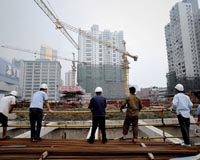
Nearly all the migrant Chinese workers laid off last year during the global economic crisis have returned to jobs in the cities due to an improvement in the employment situation, an official said Saturday.
"Currently, 96 percent rural workers who went back to the countryside have already returned to the cities to work or do business," vice agriculture minister Chen Xiaohua told reporters, stressing that "with the stabilisation and revival of the economy, employment of migrant workers has improved".
"In certain places, there are even problems of a lack of workers," he added.
"According to our investigations, at the end of the second quarter the numbers of rural workers departing for the cities increased by 2.6 percent compared to the first quarter," Chen said.
By the latest estimate, China had 225 million migrant workers.
At the start of the year, nearly 20 million of them were laid off because of factory closures due to the slump in exports amid the global economic downturn.
The Chinese authorities try to curb unemployment to avoid any social tensions which could degenerate into political unrest.
Global economic rebound 'not solid': Chinese president Hu
Chinese President Hu Jintao said Friday the global economic recovery from the worst financial crisis in decades was not solid yet, calling for stepped-up efforts by developed and emerging economies.
Although financial markets were moving towards stability, "we are soberly aware, however, that the foundation of an economic rebound is not yet solid, with many uncertainties remaining," Hu told his counterparts at the Group of 20 summit in Pittsburgh.
"A full economic recovery will take a slow and tortuous process," he told the meeting of leaders of the rich and emerging economies, including host US President Barack Obama.
Hu called on all countries to keep up the intensity of their economic stimulus plans that helped jolt the global economy from one of its most severe recessions and called for vigilance against any possibile "adverse impact" such as inflation resulting from the pump-priming measures.
"Both developed and developing economies should take more solid and effective measures and make greater effort to boost consumption and expand domestic demand," he said.
"We should stand firm in our commitment to stimulating economic growth."
Hu also sent a subtle message to the United States to rein in its ballooning budget deficit that has weakened the dollar.
"Major reserve currency-issuing countries should take into account and balance the implications of their monetary policies for both their own economies and the world economy with a view to upholding stability of international financial markets," he said.
Hu asked the G20 leaders to reject protectionism and not to impose "new restrictions" on goods, investment and services.
The United States angered China recently as its slapped steep duties on Chinese tire imports, prompting Beijing to lodge a complaint at the World Trade Organization.
Share This Article With Planet Earth
