
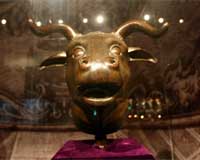
Yves Saint Laurent's partner, Pierre Berge, on Monday said he suspected China was behind the collapse of a deal to acquire two prized Chinese relics up for auction as part of the YSL collection.
In the latest chapter in a row over the relics, a Chinese antiques collector sudddenly announced Monday being the mystery bidder for the ancient bronzes looted from Beijing — but said he would not pay for them.
Speaking on French radio, Berge said he was "not very surprised" at this last twist in weeks of drama over the fate of the 150-year-old bronzes.
"The Chinese for a long time would've done anything to recover these pieces. They didn't recover them, so I imagine they pressured a potential buyer not to buy them," he said on France Info.
The bronze rabbit and rat heads, which British and French forces stole from China's imperial Summer Palace towards the end of the Second Opium War, went for 15.7 million euros (20.3 million dollars) to a mystery bidder, a purchase claimed Monday by collector Cai Mingchao.
Should Cai refuse to pay up, "I will keep them at home. That's where they were, that's where they'll return and we will continue to live together, them and me," Berge said.
Berge put up the entire 700-piece art collection he and Saint Laurent assembled together at a Paris auction last week.
Authorities in Beijing had repeatedly demanded the sale not go ahead and that the relics be returned to China.
In a statement released in Beijing by the National Treasures Fund, which is dedicated to retrieving Chinese relics from abroad, Cai said he bid for the pair of bronzes because "any Chinese person would stand up at this time."
"But I must stress that this money I cannot pay," he added.
earlier related report
Chinese bidder says will not pay for relics bought at Paris auction
A Chinese antique collector said Monday he was the mystery person behind the winning bids at a Paris auction for two relics originally looted from Beijing, but declared he would not pay for them.
The sensational announcement was the latest twist to a 150-year-old drama over the bronze rabbit and rat heads, which British and French forces stole from China's imperial Summer Palace towards the end of the Second Opium War.
The bronzes, part of the art collection of late French fashion designer Yves Saint Laurent and his partner Pierre Berge, sold for 15.7 million euros (20.3 million dollars) each at the Christie's auction in Paris last week.
Authorities in Beijing had repeatedly called for the sale not go ahead, and that the relics be returned to China.
Cai Mingchao, a well-known antique collector, identified himself as the mystery bidder in a statement released by the National Treasures Fund, which is dedicated to retrieving Chinese relics from abroad.
"I believe that any Chinese person would stand up at this time… I am making an effort to fulfil my own responsibilities," Cai said.
"But I must stress that this money I cannot pay."
The fund statement did not specify whether Cai could not pay for the relics because he did not have the money, or for other reasons, such as his conscience not allowing him to buy looted items.
In the same statement, the vice head of the fund, Niu Xianfeng, praised Cai while also saying the money "cannot" be paid.
China's official Xinhua news agency carried an English-language report quoting Niu that indicated the fund and Cai, an advisor to the body, had worked together to sabotage the auction.
"The fund faced great pressure and risks by bidding for the two sculptures, but this was an extraordinary method taken in an extraordinary situation, which successfully stopped the auction," Xinhua quoted Niu as saying.
Berge, Saint Laurent's longtime partner, said he was sure China had deliberately sabotaged the sale and added he would keep the pieces if Cai doesn't pay up.
"I will keep them at home. That's where they were, that's where they'll return and we will continue to live together, them and me," he told French radio.
Berge had previously offered to hand over the bronzes in return for "China to give human rights, liberty to Tibet and to welcome the Dalai Lama."
A spokeswoman for Christie's in London declined to comment.
"We are aware of today's news reports," she said. "As a matter of policy, we do not comment on the identity of our consignors or buyers, nor do we comment or speculate on the next steps that we might take in this instance."
According to Christie's conditions of sale, failure to pay enables the re-auctioning of a lot within a month, if the seller agrees. Should it fetch a lower price, the defaulting buyer makes up the difference.
To avoid such incidents, Christie's asks potential buyers to register ahead. The buyer must pay "immediately after the sale," the conditions say.
After the sale, China reacted furiously, with authorities warning Christie's it would face reprisals such as tougher checks on its Chinese operations.
The State Administration of Cultural Heritage said last week the auction had "harmed the cultural rights and hurt the feelings of China's people."
"(The administration) resolutely opposes and condemns all auctions of artefacts illegally taken abroad. Christie's must take responsibility for the consequences created by this auction," it said.
The bronzes were once part of a fountain that displayed the 12 animals of the Chinese zodiac.
Five of the bronzes have been returned to China with the military-run Poly Group — China's biggest arms seller — recently purchasing four of the heads at auction and putting them on display at a Beijing museum.
Gaming magnate Stanley Ho scooped up another one in 2007, a horse head for 69.1 million Hong Kong dollars (8.84 million US dollars), which is now on display at his Lisboa casino in Macau.
Cai, who is also the head of a Chinese auction house, hit the headlines in 2006 when he paid 116 million Hong Kong dollars for a Ming dynasty Buddha image at a Sotheby's auction in Hong Kong.
Share This Article With Planet Earth
