
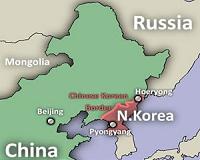
Chinese border residents were evacuated from buildings after feeling tremors from North Korea's nuclear test on Wednesday, state media reported.
People near the frontier with North Korea "clearly felt tremors" on Wednesday morning after Pyongyang said it detonated a hydrogen bomb, state broadcaster China Central Television (CCTV) said on a verified social media account.
The areas included Yanji, Hunchun and Changbai in Jilin province, it added — some of the counties closest to the North's nuclear test site.
Residents in Yanji saw desks and chairs shake for several seconds and some companies evacuated employees from their offices, it said.
Students at a senior high school were dismissed during an examination after its recreation ground cracked, it added.
China is the North's closest diplomatic ally and main provider of trade and aid, but Beijing has become increasingly frustrated with its pursuit of its nuclear ambitions and regularly calls for calm on the Korean peninsula.
Last month, North Korean leader Kim Jong-Un suggested Pyongyang had already developed a hydrogen bomb, but the claim was questioned by international experts and scepticism continued over Wednesday's test announcement.
White House vows response to any N. Korea 'provocations'
Washington (AFP) Jan 6, 2016 –
The United States said it was too early to verify North Korea's claim to have tested a hydrogen bomb Wednesday, but vowed to "respond appropriately" to "any and all provocations."
The White House has recently expressed skepticism about Pyongyang's announcement that it had perfected a device substantially more powerful than an atom bomb.
Officials said they were still investigating whether the hermit state's claim of a fourth nuclear test was true.
"We are aware of seismic activity on the Korean Peninsula in the vicinity of a known North Korean nuclear test site and have seen Pyongyang's claims of a nuclear test," said National Security Council spokesman Ned Price.
"We are monitoring and continuing to assess the situation in close coordination with our regional partners.
"While we cannot confirm these claims at this time, we condemn any violation of (United Nations Security Council) resolutions."
North Korea has previously launched three nuclear tests that brought international opprobrium and sanctions.
"We have consistently made clear that we will not accept it as a nuclear state," said Price.
"We will continue to protect and defend our allies in the region, including the Republic of Korea, and will respond appropriately to any and all North Korean provocations."
Bringing new punitive measures against Pyongyang may prove difficult, after years of extensive sanctions on North Korean entities and the need for coordination among regional actors with conflicting interests.
The White House has recently tried to focus on human rights record, rather than its military provocations.
In December, the White House poured cold water on Kim Jong-Un's suggestion that North Korea has developed a hydrogen bomb.
Spokesman Josh Earnest said the White House had concerns about the "destabilizing actions" of the regime, though available information "calls into serious question" claims that Pyongyang has a thermonuclear device.
During an inspection tour of a historical military site, Kim reportedly mentioned that North Korea was already a "powerful nuclear weapons state ready to detonate self-reliant A-bomb and H-bomb to reliably defend its sovereignty," according to official media.
