
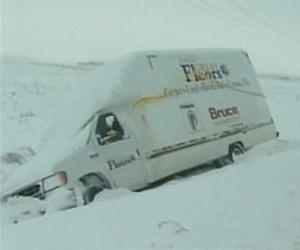
Canada on Tuesday dispatched its military to help rescue more than 200 motorists stranded in a snow storm in Ontario province, as a deep freeze gripped the region.
The Ontario Provincial Police said in a statement that a state of emergency had been declared in Lambton County southwest of Toronto, where hundreds of vehicles became trapped in the snow along a stretch of highway between London and Sarnia.
Officials said 237 people were rescued. They included at least 66 rescued by military helicopters, a defense ministry spokesman told AFP.
"All motorists on Highway 402 have been evacuated but abandoned vehicles are still on the highway. The secondary roads are now being searched for any stranded motorists," said defense spokesman Jay Paxton.
The Weather Office warned of a "snow squall" that created conditions of zero visibility, with wind chill values of minus 20 degrees Celsius (minus four Fahrenheit).
In some areas, snow was reportedly piled up two meters (six feet) high.
Despite the extreme conditions, no deaths or serious injuries have been reported.
Police were using snowmobiles and four-wheel drive vehicles to locate and extract stranded people from the highway, and the military sent three Griffon helicopters to ferry people from their vehicles to safety.
A Hercules aircraft was also combing the area for motorists trapped overnight in drifting snow and biting cold. And some area farmers were said to be using tractors to drag cars out of ditches.
Defense Minister Peter MacKay said search and rescue personnel aboard the Griffon helicopters would lower a basket onto the highway and carry motorists to a makeshift "warming area," where he said they were able to "get coffee, warm food, protection, and then make their way home."
"For someone to be trapped in their vehicle, in some cases for 20 hours, that's very serious, and these are extreme weather conditions," MacKay said.
"It's cold. If their vehicle was not running, then clearly that would be a very dangerous situation."
Many of the stranded have been using cell phones to call for help, "indicate their whereabouts, (and) indicate their well-being. That has made rescue efforts a little easier," he said.
In a few cases, people refused to leave their vehicles, preferring to wait for plows to clear the roads.
MacKay said treacherous conditions, particularly high winds, were a concern for rescuers.
Share This Article With Planet Earth
