
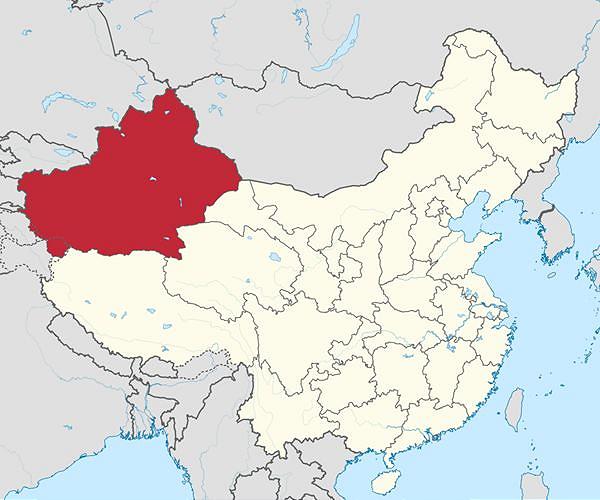
Canada on Tuesday announced a ban on the import of goods suspected of being made using forced labor in China's restive Xinjiang region, following a similar move by Britain.
In a statement, the foreign ministry said it was "gravely concerned with evidence and reports of human rights violations" against Xinjiang's Muslim Uighurs and other ethnic minorities in the autonomous northwestern region.
The ministry lashed out at what it called "repressive surveillance, mass arbitrary detention, torture and mistreatment, forced labor and mass transfers of forced laborers from Xinjiang to provinces across China."
The import ban and other measures, the Canadian government said, were rolled out in coordination with Britain and other international partners in defense of Uighur rights and to prevent goods made "wholly or in part" with forced labor "from entering Canadian and global supply chains."
Ottawa said the measures, which also include export controls, aimed to prevent Canadian businesses from becoming "unknowingly complicit" in rights violations.
Rights groups say at least one million Uighurs and other Turkic Muslims in Xinjiang have been incarcerated in camps. China describes the camps as vocational training centers intended to offer an alternative to Islamic extremism.
According to a March 2020 report by the Australian Strategic Policy Institute think tank, dozens of global brands, including Nike and Apple, have benefited from Uighur forced labor in the manufacture of their products.
Relations between Canada and China are currently at a low, following Ottawa's arrest on a US warrant of Huawei executive Meng Wanzhou and China's detention of two Canadians, a move slammed by Western nations as retaliation.
China blasts Britain at UN over criticism of Uighur treatment
United Nations, United States (AFP) Jan 12, 2021 –
China's ambassador to the UN warned Britain on Tuesday not to interfere in its affairs, after a British minister criticized Beijing's treatment of its Uighur minority during a Security Council meeting.
Zhang Jun slammed what he termed a baseless "political attack" after the speech at the Security Council from British government minister James Cleverly, which targeted alleged human rights violations against Uighurs and other minorities in China's northwestern Xinjiang region.
China's pushback also came after London earlier on Tuesday accused Beijing of abuses amounting to "barbarism" against the Uighurs, as it announced new rules to ban imports of goods suspected of using forced labour.
During the Security Council ministerial meeting, held by videoconference, Cleverly said that "threats posed by terrorism do sometimes require states to take extraordinary measures.
"However, too often counter-terrorism is used to justify egregious human rights violations and oppression," he continued.
The case of the Uighurs in Xinjiang is a "case in point," he added.
They "face severe and disproportionate measures, with up to 1.8 million people having been detained without trial. These well-documented measures are inconsistent with China's obligations under international human rights law."
Zhang accused Cleverly of "baseless attacks" which "we firmly reject and refute."
– 'Truly horrific barbarism' –
China has taken "a firm stand against terrorism and extremism," he said, calling Beijing's actions "reasonable, based on our laws, and in line with the established practice of countries around the world."
He accused Britain of applying double standards in the fight against terrorism and called on London to "stop interfering in China's internal affairs."
According to experts, at least one million Uighurs have been detained in recent years in political re-education camps in the huge region of China that borders Afghanistan and Pakistan.
International human rights groups have documented mounting evidence of forced labour, as well as forced sterilisations, torture, surveillance, and repression of Uighur culture.
Beijing has dismissed these charges, saying it is operating vocational training centers to counter Islamist radicalism following a series of attacks it attributed to the Muslim group.
Ties between China and Britain were already strained by Beijing's crackdown in Hong Kong, which the UK has protested against.
Earlier Tuesday British Foreign Secretary Dominic Raab also accused Beijing of abuses "on an industrial scale" against the Uighurs, as he anonunced the new imports ban.
"It is truly horrific barbarism we had hoped lost to another era, in practice today as we speak, in one of the leading members of the international community," he told parliament.
Raab outlined plans to bar British companies which inadvertently or deliberately profit from, or contribute to, rights violations against the Uighurs.
